Best Wedding Photo Sharing Apps for Guests in 2026

If you're searching for a wedding photo sharing app, the useful question is not simply "which app has the most features?" It is whether guests will actually use it during the reception. The strongest wedding tools remove app installs, account creation, event-code confusion, and post-wedding chasing.
The short answer: the best wedding photo sharing app for most couples is a no-app QR upload flow with clear privacy, video/audio support, enough retention, and one full-quality download after the wedding. A polished app store listing matters less than guest participation.
Key takeaways
- Ubersuggest shows wedding photo sharing app and wedding picture sharing app at 720 monthly searches each, with moderate SEO difficulty in the latest MCP export.
- Start with guest friction: QR upload, no install, no signup, and clear table-card instructions usually matter more than extra admin features.
- Compare privacy, retention, video/audio support, moderation, and export rights before choosing a wedding album tool.
Best wedding photo sharing apps for guests
A wedding photo sharing app for guests should be judged by participation first. QR adoption is mainstream enough for wedding tables: TEAM LEWIS reported that 68% of consumers used a QR code in the previous year, and MobileIron found that 86.66% of UK/EU smartphone users had scanned one at least once. If the upload flow stays in the browser, guests already know the behavior.
Use this table as the first shortlist filter:
| Option type | Guest install? | QR upload | Photos/videos | Voice messages | Export | Privacy fit | Best-fit wedding size |
|---|---|---|---|---|---|---|---|
| Browser QR album | No | Yes | Usually yes | Sometimes | Strong when ZIP is included | Strongest when retention and EU hosting are clear | Small to large |
| Dedicated wedding app | Often yes | Sometimes | Usually yes | Varies | Varies | Depends on account and hosting model | Tech-comfortable groups |
| Shared cloud album | No dedicated app, but account friction | Link-based | Photos/videos | No | Manual or platform-specific | Weak if access is too broad | Small groups |
| Group chat | No | No | Compressed media | Voice notes mixed into chat | Poor | Weak discoverability and consent context | Very small gatherings |
The best app-style experience is often not a native app at all. For weddings, the better question is whether the tool behaves like a useful guest utility: scan, upload, done. That keeps grandparents, international guests, and late-night dance-floor contributors in the same workflow.
Decision matrix by wedding scenario
Different weddings need different limits. Pick the scenario first, then compare tools.
| Wedding scenario | Best-fit tool pattern | Why it matters |
|---|---|---|
| Small civil wedding | Free or low-cost QR album | A short retention window can be enough when the guest count is low. |
| Multilingual wedding | Browser upload with language-aware signs | Guests should not have to guess what the upload page is asking. |
| Private family album | Closed gallery with clear retention | Children, elderly relatives, and emotional moments need tighter sharing defaults. |
| Live slideshow reception | Moderated QR album with venue-screen support | Public screens need host control before photos appear. |
| Long-term archive | Paid tier with batch download and longer retention | Couples need time to download originals after the honeymoon. |
Why app-free upload matters
App installs reduce participation because every extra step creates a drop-off point. A guest has to open the store, install software, accept prompts, create an account, find the event, and remember why they started. At a reception, that is too much work for a quick candid photo.
No-app QR upload is different. A table card gives guests one task, and the phone camera does the rest. That is why this page links practical setup work to collect wedding guest photos, richer memory capture to digital wedding guestbook apps, and print planning to QR code wedding photo sharing templates.
Short Answer
Gathmo offers four per-event tiers: Free, Essential at EUR19, Celebrate at EUR39, and Grand at EUR79, with guests rising from 30 to unlimited and retention rising from 30 days to 365 days. For couples building a shortlist of no-app wedding photo sites, that makes the first decision practical: pick the tool whose limits fit the event before comparing cosmetic features.
For a small event, GuestCam or another free option may be enough if all you need is a QR upload page and a short-lived gallery. The risk is assuming that "free" also covers a larger guest list, long-term storage, audio messages, data-processing paperwork, or a venue screen. Most tools split those capabilities across paid plans, add-ons, or business tiers.
For a corporate event or a wedding with mixed-age guests, guest friction matters more than a dense feature list. A no-app, no-signup flow gives guests one job: scan and upload. If the tool asks guests to install an app, create an account, search for an event code, or wait for manual approval before uploading, participation usually drops before the host sees the first photo.
The cleanest shortlist has three columns. First, what guests experience on the day. Second, what the host receives after the event. Third, what legal or operational assurances are available if the event involves employees, children, clients, or cross-border data. A tool can win one column and still lose the decision if another column is non-negotiable.
The best comparison is not a vendor ranking. It is a mismatch test. If your event needs face-find today, Gathmo is not the right answer because Gathmo does not offer face-find today. If you need EU-hosted photo, video, and voice collection with no guest signup, the shortlist changes immediately.
Comparison Criteria
QR-code adoption is no longer a niche assumption: TEAM LEWIS reported that 68% of consumers had used a QR code in the previous year, while MobileIron found that 86.66% of UK/EU smartphone users had scanned a QR code at least once. That supports a QR-first event flow, but only when the post-scan experience stays simple.
Use these criteria before you compare slogans:
| Criterion | What to check | Why it matters |
|---|---|---|
| Guest upload flow | QR/browser, app, account, event code | The more steps guests face, the fewer casual moments they upload. |
| Guest cap | Free and paid limits | A 30-person dinner and a 180-person wedding need different headroom. |
| Media support | Photos, videos, voice messages, transcripts | A photo gallery and a digital guestbook are not the same product. |
| Retention | Days, months, extension options | Short retention can be fine for parties and wrong for weddings. |
| Moderation | Manual, AI, host approval | Public screens and corporate events need safer filtering. |
| Download rights | Batch ZIP, original quality, item limits | The host needs a clean archive after the event. |
| Data location | EU, US, unknown, processor paperwork | EU hosts need clearer answers than "secure cloud." |
For commercial investigation searches, put the reader's actual event into the table. A planner running five client events per month should care about reusable branding, custom domains, and account hierarchy. A couple planning one wedding should care about guest ease, retention, QR signage, and whether grandparents can upload without asking for help.
the market sources include pricing pages, comparison pages, blog resources, and free QR-code tools. That mix is useful because it shows how competitors frame the same buyer problem from several angles: cost, alternative positioning, guest upload convenience, and print-ready QR workflows.
Best-Fit Recommendation
Around 70% of camera-phone photos are never revisited in any meaningful way, according to Popsa's Memory Economy research cited in the local market register. The winning tool is therefore the one that prevents event photos from disappearing into private camera rolls while keeping the process simple enough for real guests.
For a one-off private event, choose the option that fits the guest count and retention window with the least setup. If GuestCam already covers your needed media types and your privacy requirements, it may be the right answer. If the event needs voice messages, stronger host control, or a clear EUR per-event structure, Gathmo deserves a side-by-side comparison.
For a corporate event, the decision should be stricter. Employee photos can create additional data-protection questions, and the German BDSG employment context makes casual publication a poor default. A company event usually needs visible notices, a defined purpose, retention rules, and a way to remove content when a person objects.
For weddings, the emotional value is higher and the failure mode is different. A couple can forgive a plain admin screen; they will not forgive missing guest videos, expired galleries, or a download process that becomes another post-wedding chore. Retention, batch download, and video length matter because the photos are not disposable marketing assets.
For agencies, the question is whether the tool can be repeated. Per-event pricing works for single hosts. A reseller or planner needs account structure, branding depth, client separation, and predictable costs. If those needs are present, compare B2B plans rather than forcing a personal-event tier into a professional workflow.
Feature and Pricing Notes
Gathmo's B2C pricing is EUR-only: Free, Essential EUR19, Celebrate EUR39, and Grand EUR79 per event. The same pricing structure has unlimited guests on all tiers, with uploads capped at 100 on Free and unlimited on paid tiers, and retention of 30 days on Free, 6 months on Essential, 1 year on Celebrate, and 2 years on Grand.
Use the competitor notes below as a practical starting point, then re-check each live pricing page before purchase because plans can change without notice.
| Option | Pricing note to verify | What to watch |
|---|---|---|
| GuestCam | GuestCam is listed as Standard $49 and Premium $97 one-time, with MagicFind as a $45 add-on and US-based hosting in recent competitor review. | Verify live pricing before purchase |
The table shows why price alone is a weak buying guide. A cheaper plan can be expensive if it misses the one feature your event needs: audio messages, video length, face-find, EU data handling, or a batch export. A more expensive plan can be overkill if you only need 50 casual party photos for two weeks.
Gathmo's launch limitations also need to stay visible. Gathmo does not currently focus on RSVP or face-find. If either is mandatory today, point the reader toward a tool that currently offers it. That honesty reduces conversion pressure in the short term, but it protects trust and makes the comparison more useful.
Privacy and Guest-Friction Notes
GDPR Art. 5 requires data minimisation and storage limitation, and Art. 13 requires clear information when personal data is collected. For event media, that means the upload page should explain who controls the event, why media is collected, how long it stays available, and how guests can exercise rights.
This is where the difference between a private birthday, a wedding, and a corporate event becomes material. A birthday host may only need a simple closed album and short retention. A corporate host may need a DPA, internal approval, employee-facing notices, and a more conservative default around live screens or public sharing.
Data residency does not make a tool automatically compliant. It does, however, make the risk analysis simpler for EU hosts. recent competitor review marks some tools as EU-resident, some as US-hosted, and some as unclear. Treat "unknown" as a question to resolve before purchase, not as a harmless blank.
Guest friction is the other half of trust. A guest who sees a clear QR sign, a short privacy note, and a browser upload button can make a quick decision. A guest who has to install an app or register may decide the moment is not worth the work. What happens in those first 20 seconds shapes the whole album.
For Gathmo's content model, the practical editorial rule is simple: never recommend a tool only because it has more features. Recommend the tool that matches the event's risk profile, guest behavior, and retention needs. Feature density is not the same as event fit.
Setup Checklist
Smartphone penetration in Germany was forecast at about 97% in 2024, according to Statista in the local market register. That makes QR-based guest upload realistic for most DACH events, but the host still needs clear signage, a working fallback, and a privacy-safe collection flow.
Before choosing GuestCam or any alternative, walk through this checklist:
- Count real participants, not just invited guests. Include plus-ones, vendors, colleagues, and relatives who may upload.
- Estimate media volume. A lively wedding can produce more photos and videos than a free tier expects.
- Decide how long the album should stay online before the event happens.
- Check whether videos and voice messages are core memories or nice-to-have extras.
- Confirm whether a venue screen, live slideshow, or broadcast is required.
- Verify data residency, DPA availability, and guest notice requirements.
- Test the QR code on iPhone and Android before printing signs.
- Download the full archive after the event, even if the platform keeps it online.
For print materials, keep the instruction shorter than the design. "Scan to upload your photos and voice messages" is better than a paragraph. Add the privacy note beside or below the QR code, not hidden in tiny footer text. Guests should understand both the action and the boundary.
For multilingual events, prepare one QR sign per language or use language-aware landing pages. A German-English wedding or corporate event should not force one side of the guest list to guess what the upload page is asking for. Language friction is still friction.
Related Gathmo Guides
These articles support the next decision step and give the comparison clear internal context:
- Wedding Guest Photo Sharing: How to Get Every Photo from Every Guest's Phone: Use this guide when you need to clarify QR flow, privacy requirements, guest communication, or budget boundaries before choosing a tool.
- Wedding QR Code for Photos: The Complete Setup Guide (With Free Sign Templates): Use this guide when you need to clarify QR flow, privacy requirements, guest communication, or budget boundaries before choosing a tool.
- Digital Wedding Guestbook Apps: Photos, Voice Messages, and QR Albums Compared: Use this guide when a photo-only app is not enough and guests should also leave videos or voice notes.
- Event Photo Sharing Pricing Compared: Use this comparison when price, retention, and media limits are the deciding factors.
- Best Event Photo Sharing Apps in 2026: An Honest Comparison: Use this guide when you need to clarify QR flow, privacy requirements, guest communication, or budget boundaries before choosing a tool.
Review these supporting articles once more before publication so anchor text, search intent, and canonical URL stay aligned.

- No app or signup for guests
- Voice messages built in on every tier
- EU data residency
- Clear retention windows per tier
- Batch ZIP export
- Face-recognition search not yet available
- RSVP not in launch product
- Face-search add-on available
- Established product
- Clear one-time pricing
- US-hosted, no EU data residency
- No free tier
- Voice transcripts not available
Frequently asked
For EU couples wanting no-app uploads, photos, video and voice messages in one album, and EU data residency, Gathmo is the most complete pick. Most couples choose the €39 Celebrate tier: unlimited guests, 1 year of album storage, a live slideshow for the reception, and the audio guestbook included from the free tier. Paid plans from €19 per event (verified June 2026).
Not always, and cheapest is not the right first question. Gathmo's Free tier is EUR0 and paid B2C tiers start at EUR19, while competitor pricing can use mixed EUR, USD, AUD, and monthly models. Compare guest limits, retention, downloads, and media types before comparing currency.
The best wedding photo sharing platforms in 2026 all support browser-native guest uploads. Gathmo and several competitors let guests scan a QR code and upload from the phone camera with no app install and no account. Always verify the guest upload flow for any platform you consider before printing your QR code signs — app-required flows cut participation at weddings.
Check data residency, processor paperwork, retention, deletion rights, and the guest-facing information notice. GDPR Art. 13 requires clear information at collection, and Art. 5 requires storage limitation and data minimisation. EU hosting helps, but it does not replace a clear processing setup.
Paid wedding photo sharing plans typically unlock: unlimited uploads (versus a 100-photo free cap), extended retention (183–730 days versus 30 days), guest video beyond 3 minutes, voice message guestbook, a live photo wall, custom branding, and watermark removal. For a wedding — a once-in-a-lifetime event — the upload cap and 30-day retention window are the two risks most worth paying to eliminate.
Retention varies significantly across platforms. Gathmo offers 30 days on free, 183 days on Essential (EUR19), 365 days on Celebrate (EUR39), and 730 days on Grand (EUR79). Some competitors offer indefinite storage with size or quality limits. Whatever platform you choose, download your full archive within the first week after the wedding — cloud retention is insurance, not the archive.
The right answer depends on what you are sharing. For professional photographer delivery (large, edited files), Pixieset, Shootproof, or SmugMug are the industry standard. For guest-collected candids using a QR album during the reception, Gathmo, GuestCam, or Kululu are the category leaders. For EU couples who need GDPR compliance and EU data residency, Gathmo is the strongest option: EU-hosted (Frankfurt), DPA available, no-install guest uploads, audio guestbook on every tier. Most couples use both — a professional gallery for edited shots and a QR album for candid guest photos. Retention is the most commonly overlooked comparison point: look for a minimum of 1 year, not 30 days.
 Story
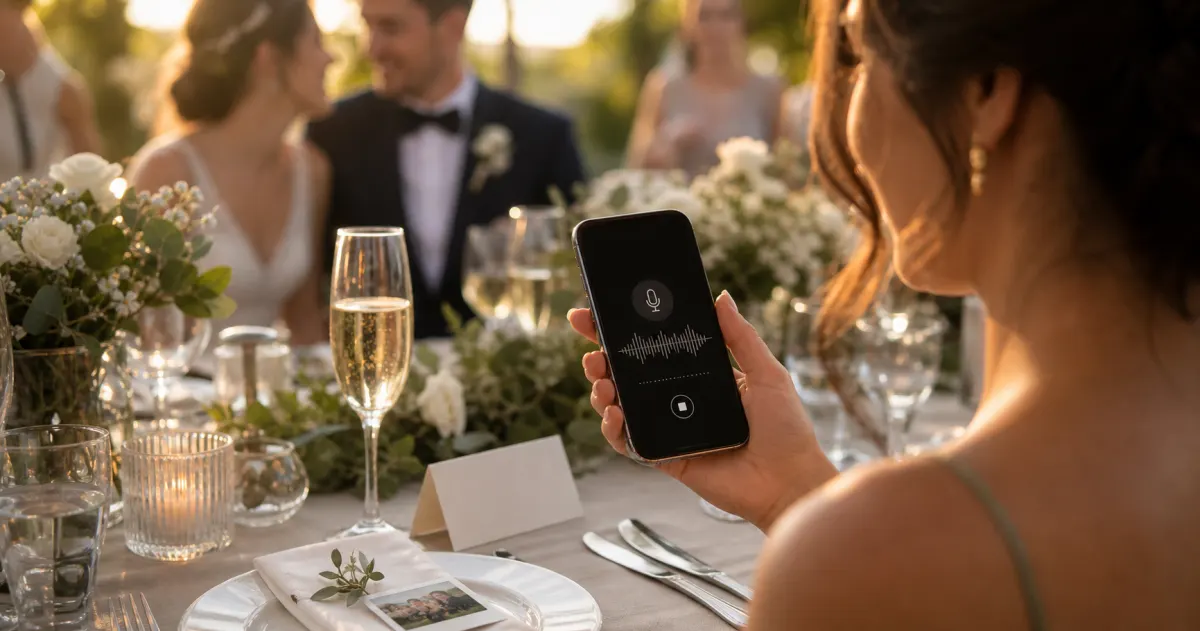
StoryThe most underrated wedding keepsake: guest voice messages
Guest voice messages are the wedding keepsake couples replay most -- real voices, real pauses, the things people said when they actually meant them.
 Ranking
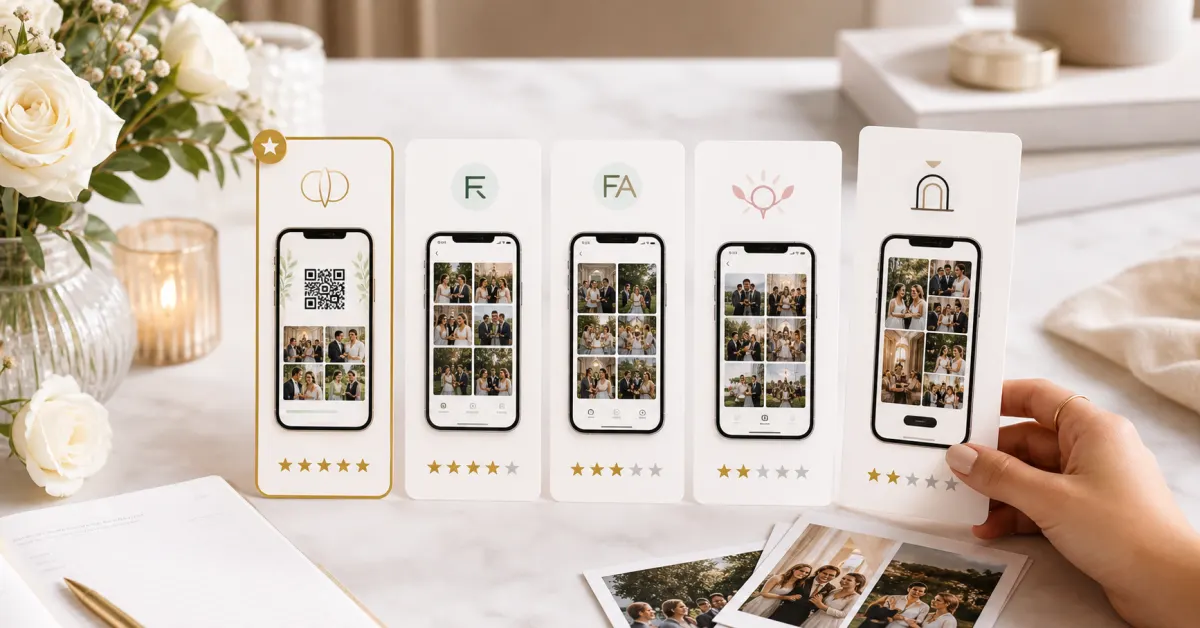
Best wedding guest photo apps of 2026
We compared the wedding guest photo apps couples actually use -- on price, friction, and what you keep afterward. Our ranked best-of for 2026.
 Guide
GuideAudio guestbook for weddings: skip the rental
An audio guestbook used to mean renting a retro phone for hundreds of euros. How to collect wedding voice messages with a QR code instead.