GDPR for Wedding Hosts: What Happens to Your Guests' Photos Under EU Law


A wedding is the most photographed day of your life. Hundreds of photos, a handful of videos, and — if you've set it up — voice messages from the people you love, all flowing in from your guests' phones. It's beautiful. It's also, in the eyes of EU law, a large pile of other people's personal data that you are now responsible for.
That sounds heavier than it is. You do not need a lawyer to collect wedding photos, and you are not about to break the law because Aunt Renate uploaded a blurry shot of the cake. But because your guests include children, elderly relatives, and people who would quietly hate to see themselves online, it's worth understanding what GDPR actually asks of you — and how to set things up so the answer is "nothing you weren't already going to do."
This guide is written for couples and their helpers, not for compliance officers. It is not legal advice; for your specific situation, ask a qualified professional. But every legal point below is tied to a named article of the GDPR, so you can check the source yourself.
The short version. For ordinary wedding photos, you almost always have a lawful basis. Your real jobs are: tell guests what's happening, honour a request to delete someone, don't keep everything forever, and — the one most people miss — care about where the photos are physically stored. A tool built in the EU does most of this for you.
Does GDPR even apply to my wedding photos?
Mostly, the honest answer is: less than you'd fear, but not nothing.
GDPR carves out an exemption for processing done "by a natural person in the course of a purely personal or household activity" (Art. 2(2)(c), read with Recital 18). A guest keeping their own snaps of your wedding on their own phone, for their own memories, sits comfortably inside that household exemption. So does you, privately, keeping the album.
Two things pull you back out of that comfort zone:
- Publishing outward. The exemption is read narrowly. In the Ryneš case (C-212/13), the EU Court of Justice held that processing "directed outwards from the private setting" — there, video surveillance covering a public space — cannot count as a purely personal activity. Applied to a wedding, the moment you publish photos of other people beyond a closed private circle — say, a public Instagram grid or an open web gallery — you're likely outside the household exemption, and GDPR's full obligations can attach to you.
- The tool you use is never exempt. The household exemption shields the individual. It does not shield the company providing the platform. Whatever app collects and stores the photos is processing personal data within GDPR's scope, full stop. That's exactly why where and how your photo tool operates matters more than your own paperwork.
So: a private album shared with people you invited? Light-touch. A public free-for-all? Heavier. The tooling underneath? Always in scope — which is the part you should be choosing carefully.
Do I need everyone's consent to collect their photos?
This is the question that makes hosts nervous, and the good news is that consent is usually not the basis you're relying on for ordinary photos.
Under Art. 6(1), any processing needs a lawful basis. The two that matter for a wedding are:
- Consent (Art. 6(1)(a)) — which must be "specific, informed and freely given." Chasing every guest for documented consent before they upload a photo would be impractical and is not usually necessary for ordinary, non-special-category event photos.
- Legitimate interest (Art. 6(1)(f)) — available where the processing is necessary for your interests and those are "not overridden by the interests or fundamental rights and freedoms of the data subject." For ordinary, non-sensitive wedding photos, a host can generally rely on legitimate interest: collecting memories of a private celebration with invited guests is a textbook reasonable interest.
The register's plain-language takeaway: for ordinary, non-special-category event photos a host can generally rely on legitimate interest, but consent is the safer basis (and is required) where the balance fails or special-category data is involved. In practice that means be more careful with children's images and with anyone who's explicitly asked not to be photographed.
There is one place where consent becomes non-negotiable, and it's worth its own section.
The face-recognition trap
A normal photo of a face is not automatically "special category" data. Recital 51 is explicit: photographs "should not systematically be considered to be processing of special categories of personal data" — they become biometric data, and fall under the stricter Art. 9, only when "processed through a specific technical means allowing the unique identification or authentication of a natural person."
Translated: storing and displaying photos is fine. Running face recognition to match and tag who's who crosses into Art. 9(1) biometric processing, which is prohibited unless you have a specific Art. 9(2) ground — typically separate, explicit consent from each person. Several wedding-photo tools market face-search as a headline feature. If you enable that, you've quietly taken on a much heavier consent obligation.
This is a deliberate design choice for Gathmo: it does not offer face-recognition photo search (it's on the roadmap, not in the product today). Your guests' faces are stored and shown as photographs — not converted into searchable biometric templates — so you stay on the ordinary-photo side of the line by default.
What do I have to tell my guests?
When you collect personal data directly from people, GDPR (Art. 13(1)) says you should, at the point of collection, give them a clear set of basics: who's in control of the data, why you're collecting it, the legal basis, how long you'll keep it, and their rights. For a wedding, that's not a stiff legal notice on every table — it's one friendly line at the point guests scan and upload.
Something as simple as this does the job:
"Photos and voice messages you share here go into [Couple]'s private wedding album, stored on EU servers and deleted after the album closes. Don't want to appear? Just let us know."
A good photo tool surfaces this for you on the upload screen, so you're not drafting privacy notices on your wedding morning. The point isn't formality — it's that nobody is surprised by where their photo ended up.
Someone asks you to delete their photo. Now what?
Guests have a right to erasure — the "right to be forgotten" (Art. 17(1)). If someone withdraws from the album, or there's simply no longer a good reason to keep their image, they can ask you to delete their personal data, and you must act "without undue delay."
How long is that? GDPR gives a hard outer limit: you must respond within one month of the request (Art. 12(3)), extendable by two further months for genuinely complex or high-volume cases, provided you tell the person about the extension within that first month. For a wedding, this is almost never complicated — you find the photo, you delete it. The deadline exists; you'll rarely need most of it.
Practically, this is far easier on a platform where you (the host) can remove an individual photo or a guest's whole contribution from a dashboard, rather than begging a group chat to "please take that one down." Gathmo's albums are moderated and host-controlled, with a review queue, so honouring a quiet "could you take that one out?" is a two-click job, not a negotiation.
You can't keep everything forever (even though you'll want to)
GDPR's storage-limitation and data-minimisation principles (Art. 5(1)(e) and 5(1)(c)) say personal data should be kept "for no longer than is necessary" and limited "to what is necessary." Indefinite storage of guests' images, with no end date, is exactly what the law nudges you away from.
Here's the emotional twist, and it's a real tension on a weddings site: you want these voices and faces kept forever. The way to honour both — the law and the longing — is straightforward. Set a generous, defined retention window, download the full-quality album as your permanent personal copy, and let the shared online album expire on schedule. Your forever lives on your own drive; the cloud copy has a sensible end date.
Gathmo's retention is built around exactly this, and scales with the tier:
| Gathmo tier | Album retention | Notes |
|---|---|---|
| Free | 30 days (+14-day grace) | Try it / micro-events |
| Essential (€19) | 183 days (6 months) | — |
| Celebrate (€39) | 365 days (1 year) | Most couples' choice |
| Grand (€79) | 730 days (2 years) | Plus voice-message transcripts |
When the retention window closes, the shared album should not remain online indefinitely. Gathmo's product facts define finite retention windows by tier, and the batch ZIP download (on every paid tier) is how you keep the memories themselves: full quality, on your own storage, where "forever" actually belongs.
The part most hosts miss: where the photos physically live
You can do everything above carefully and still choose a tool whose hosting creates international-transfer questions. For a German or French wedding especially, data residency is one of the most important checks.
If personal data is transferred outside the EU — to, say, US-based cloud storage — that transfer is only lawful under specific conditions (GDPR Chapter V): an adequacy decision (Art. 45) or appropriate safeguards such as Standard Contractual Clauses (Art. 46). The legal backdrop here has been turbulent: Schrems II (C-311/18) struck down the old Privacy Shield while keeping SCCs alive, and the newer EU-US Data Privacy Framework adequacy decision (in force since July 2023) is itself still being litigated — the EU General Court dismissed the first challenge in September 2025, with an appeal pending before the CJEU. Usable today, but not risk-free, and not the thing you want to be thinking about at all on your wedding day.
The clean way to avoid the entire question is to keep the data in the EU in the first place. Then there's no third-country transfer to assess.
This is where wedding-photo tools genuinely differ — and the data digest (verified June 2026, native currencies, "as of June 2026") shows it's a real fault line:
- US-hosted, explicitly: GuestCam states US-based cloud storage; Kululu stores primarily on US Google Cloud (Firebase); Wedibox and Fotify are US companies.
- EU residency unknown or not confirmed: Guestlense and several others don't state where data lives. Where a competitor's EU residency is low-confidence, treat it as not confirmed rather than assume either way.
- EU-hosted: A cluster of German and EU tools — including EventPics, FridaySnap, Weddies, Lense, and JoinMyMoment — do host in the EU.
Gathmo sits firmly in that last group, and leans into proof rather than a vague badge: photos, videos, and voice messages are stored with EU data residency — object storage in the EU jurisdiction, a Postgres database in Frankfurt, EU compute, and signed Data Processing Agreements with its processors. Worth being precise: EU hosting is real here, but Gathmo isn't the only EU-resident option, and we won't pretend otherwise. The edge is the combination — EU-resident storage plus the audio guestbook (voice messages on every tier; full transcripts on Grand) plus host-controlled, moderated albums — held together in one place.
A quick note on who's responsible for what
In GDPR terms, you (the couple/host) are the controller — you decide why and how the data is processed. The platform is your processor, acting on your instructions. That relationship is supposed to be governed by a written Data Processing Agreement (Art. 28(3)) covering security, sub-processors, assisting you with guests' rights, and deleting or returning data when the service ends. Gathmo's product facts record customer DPA availability for hosts; for any vendor, ask directly: "Do you give hosts a DPA?"
One more wrinkle if children will be uploading: the digital age of consent for online services is 16 in Germany (no derogation) and 14 in Austria (§ 4(4) DSG); below that, a parent has to consent. For a typical wedding this rarely bites — but it's another reason not to enable anything that processes minors' data more intensively than plain photos.
Determine whether GDPR applies to your wedding
The GDPR household exemption (Art. 2(2)(c)) covers personal processing by individuals in the course of purely personal activities. A private wedding for family and friends falls under this exemption and does not require formal GDPR compliance steps for photo collection.
Take basic reasonable steps for guests' privacy
Even under the household exemption, best practice is to inform guests that photos will be collected and shared, give them a way to opt out if they have concerns, and avoid storing photos indefinitely. These are courtesy measures, not legal requirements for private events.
Use a private album, not a public sharing service
Store wedding photos in a private album (Gathmo's default) rather than a public social media album or an unsecured shared link. Private means only people with the specific link can access it -- not searchable and not indexed by search engines.
Delete the album after sharing with family
Once you have shared your curated photos with family and guests -- typically 6 to 12 months after the wedding -- delete the album from the platform. In the Gathmo dashboard, open the event and delete it. This is good data hygiene regardless of legal requirements.
Frequently asked
It can. Photos of identifiable people are personal data. A guest privately keeping their own photos is generally covered by the household exemption (Art. 2(2)(c)); publishing photos of others publicly, or running a platform that collects them, brings GDPR into play. Your photo tool is always within scope.
Not usually for ordinary photos — a host can generally rely on legitimate interest (Art. 6(1)(f)) rather than collecting formal consent. Consent (Art. 6(1)(a)) becomes the safer or required basis for sensitive cases, and is effectively required if you use face recognition, which triggers the stricter biometric rules under Art. 9.
Privately, within a closed circle of invited guests, you're on solid ground. Publishing other people's images publicly is riskier: it can fall outside the household exemption (per Ryneš) and should respect anyone who's asked not to appear. When in doubt, keep the album private and ask before posting individuals.
There's no fixed number — the rule is "no longer than necessary" (Art. 5(1)(e)). The practical answer: set a defined retention window, download your own permanent full-quality copy, and let the shared online album expire. Gathmo's shared albums run from 30 days (Free) up to 2 years (Grand), then delete.
Under the GDPR, you need a lawful basis and transparency. For a private wedding where you are collecting guest-uploaded photos in a closed album shared only with participants, legitimate interest is the most defensible basis — guests attending a wedding reasonably expect photos to be taken and shared among those present. Transparency means a brief notice: a line on the wedding website or a note on the QR card such as Photos collected here are shared privately with the wedding party and guests. You do not need a formal privacy notice or consent tick-box for a private album shared only with attendees. Consent is required if you plan to use photos in public marketing or contexts guests would not reasonably anticipate.
In the EU, the wedding photographer is typically an independent data controller for the images they capture and edit. A DPA is required under Art. 28 GDPR when one entity processes personal data on behalf of another. The cleaner arrangement for a wedding photographer is to include a brief data-processing clause in the client contract: specifying what data is collected (RAW files, edited JPEGs), how long the photographer retains copies (standard is 3 to 6 months after delivery), and that the couple takes responsibility for their distribution of the final images. This is not a complex legal document — it is a paragraph in the existing contract.
For a private wedding among family and friends, GDPR's household exemption (Art. 2(2)(c)) typically applies — no formal privacy notice is required for photos taken and shared within that social circle. The exemption has limits: if you post photos publicly on social media, share with people outside the guest list, or use a third-party platform (where the platform becomes a data processor under Art. 28), the exemption may not fully apply. For the QR album, using a platform with a GDPR-compliant DPA (such as Gathmo) means the DPA covers the platform's processing. No formal guest privacy notice is required for a typical private wedding; a sentence in the order of service about photo collection is a simple transparency measure if you want to be thorough.
 Story
StoryThe most underrated wedding keepsake: guest voice messages
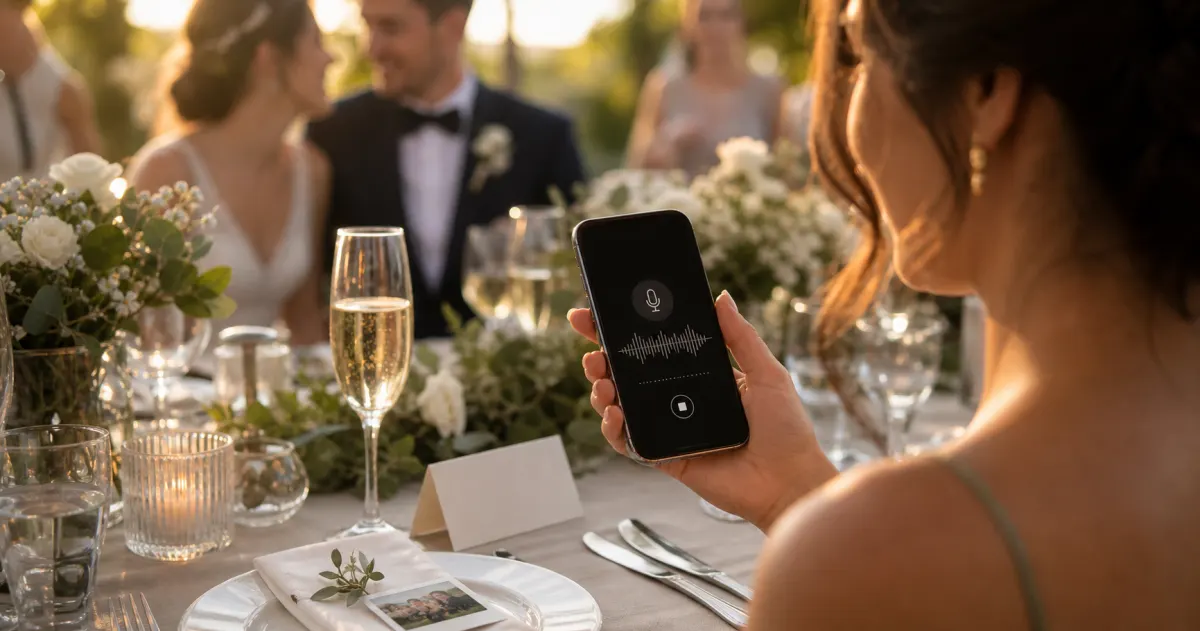
Guest voice messages are the wedding keepsake couples replay most -- real voices, real pauses, the things people said when they actually meant them.
 Ranking
Best wedding guest photo apps of 2026
We compared the wedding guest photo apps couples actually use -- on price, friction, and what you keep afterward. Our ranked best-of for 2026.
 Guide
GuideAudio guestbook for weddings: skip the rental
An audio guestbook used to mean renting a retro phone for hundreds of euros. How to collect wedding voice messages with a QR code instead.