Wedding Voice Messages vs. a Traditional Guestbook: Pros, Cons, and Ideas

There is a small, paper book on a table near your reception entrance. By the end of the night it will hold a few dozen signatures, some hearts, the occasional inside joke, and at least one toddler's crayon spiral. You will open it once, the week after the wedding, and then it will live in a drawer.
That is not a criticism of the guestbook. It is one of the oldest, gentlest wedding traditions there is, and there is real warmth in a page of your grandmother's looping handwriting. But more and more couples are asking a fair question: of everyone we love who came to this day, is a row of names really the best thing we get to keep?
An audio guestbook — where guests leave a short spoken message instead of (or alongside) a signature — answers that differently. Instead of "John & Mary, congrats!" you keep John's actual laugh, the three-second pause before your best friend says the thing she could never write down. This guide compares the two honestly: what each does well, where each falls short, and how to combine them so nothing about your day gets lost.
The short version. A traditional guestbook is beautiful, foolproof, and tactile, but it captures words, not people. An audio guestbook captures voices — tone, laughter, accents, emotion — and you do not have to choose: the best setups keep the paper book on the table and add a QR code beside it so guests can do both in a minute.
What is a wedding audio guestbook?
If you have only ever seen the paper kind, here is the plain version. A wedding audio guestbook is a way for guests to record a short spoken message to you — a memory, a wish, a toast they were too shy to give out loud — that you keep as a recording rather than a written line.
There are three broad ways it gets done at weddings today:
- A vintage phone or "audio booth." A retro handset on a side table; guests pick it up, hear a beep, and talk. It is lovely — but it is usually a hardware rental you book for one day, with one device, one queue, and a return deadline the next morning.
- A dedicated app guests download. Some tools ask each guest to install something first. At a wedding, where guests range from teenagers to great-aunts, "please download our app first" is exactly the friction you are trying to avoid.
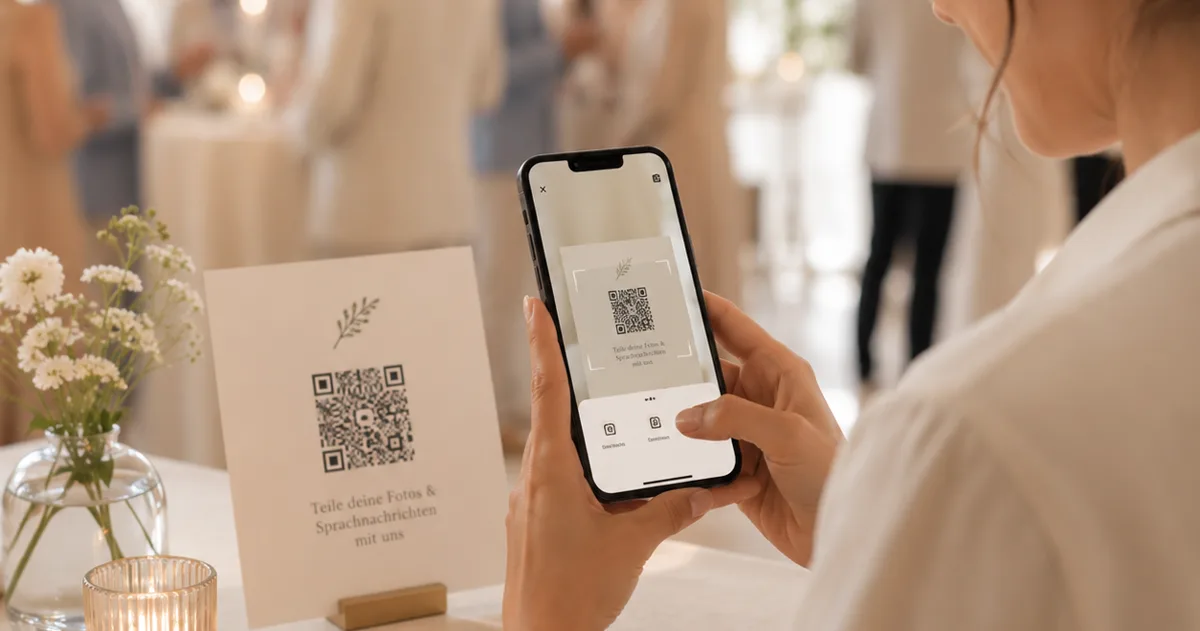
- A QR code to a webpage — no app, no booth. Guests scan a code on the table, their phone browser opens, they tap record, and they speak. No rental, no hardware to return, no app to install, and no single-device queue. This is the approach Gathmo uses: guests scan a QR or open a short link and upload photos, videos, and voice messages with no app and no signup (source: research-foundation/07-gathmo-product-facts.md, GATHMO-004, GATHMO-030/031/032).
The third option matters most below, because it removes the two biggest practical complaints about audio guestbooks — the cost of hardware and the friction for guests — while keeping the thing that makes them special: the voice.
The traditional guestbook: pros and cons
Let's be fair to the classic. It has earned its place on the table.
What a paper guestbook does well
- It is completely foolproof. A pen and a page work for everyone, at every age, with no battery, no signal, and no scanning. Your 92-year-old great-uncle does not need a tutorial.
- It is tactile and permanent in a physical way. You can hold it. You can put it on a shelf. Handwriting carries something a transcript never will — the pressure of the pen, the doodle in the margin.
- It is private by default. A closed book on a table is about as low-stakes, data-wise, as a wedding keepsake gets.
- It is cheap and self-contained. No subscription, no servers, nothing to set up.
Where it falls short
- It captures words, not people. "Wishing you a lifetime of happiness" is kind, but it is not your friend's voice saying it.
- Most guests write the same three lines. Faced with a blank page and a queue forming behind them, people default to the safest, shortest thing.
- It is easy to lose, spill on, or forget. One book, one table, one rogue glass of red wine.
- You rarely revisit it. This is the quiet tragedy of a lot of wedding mementos. Research on everyday photography found that around 70% of camera-phone photos are never revisited, with only 27.8% ever looked at again in any meaningful way (Popsa / Digital Camera World, 2025). A drawer-bound guestbook lives a similar fate — beautiful, and rarely opened.
The audio guestbook: pros and cons
Now the newer option, with the same honesty.
What an audio guestbook does well
- It keeps the voice, not just the words. This is the entire point. Tone, laughter, the accent of a relative who lives abroad, the wobble in a parent's voice — none of that survives on paper. On audio, it is all there, exactly as it was said.
- It loosens people up. Something about speaking instead of writing gets guests past the generic. A spoken thirty seconds tends to be more honest, funnier, and more specific than a written line squeezed onto a shared page.
- It captures the people who would never sign. The uncle who hates "all that mushy stuff" will happily leave a deadpan one-liner into a phone. You get him too.
- It is genuinely permanent — and you will play it back. Years later, the recording is exactly as warm as the day it was made. This is the part of the day that never makes it into the wedding film or the photographer's gallery. For a relative who is older or unwell, a saved message can become one of the most treasured things you own.
Where it falls short — and how to handle it
- A few guests are camera-shy or "mic-shy." Some people freeze at a recording prompt. The fix is the combination, not a replacement: keep the paper book for the shy, add audio for the rest.
- Hardware-based versions have real limits. A rented vintage phone is one device with a queue, a rental fee, and a return deadline. The QR-code approach removes all three — every guest uses their own phone, in parallel, at their own table.
- You need to be able to find and replay the messages. A pile of recordings is only a keepsake if it is organised. With Gathmo, voice messages arrive in a dedicated section of your album with a waveform player, and on the top tier each one comes with a full text transcript so you can read them too (source: research-foundation/07-gathmo-product-facts.md, GATHMO-032/033).
- It involves guests' personal data, so where it is stored matters. A spoken message is personal data. We cover the privacy side below — it is more reassuring than you might expect.
Audio guestbook vs. traditional guestbook: side by side
| Traditional paper guestbook | Vintage-phone / rental audio | QR-code audio guestbook (e.g. Gathmo) | |
|---|---|---|---|
| What you keep | Handwritten lines | Voice recordings | Voice recordings (+ transcript on Grand) |
| Guest effort | Pick up a pen | Pick up a handset, wait for the booth | Scan a code, tap record — own phone, no app |
| Works for all ages | ✅ Always | ✅ Usually | ✅ Any phone, no app or signup (GATHMO-030/031) |
| Parallel use | One book, one queue | One device, one queue | Every guest at once |
| Hardware to return | None | Yes — rental, next-morning deadline | None |
| Captures tone & laughter | ❌ | ✅ | ✅ |
| Searchable / readable later | ❌ | ❌ | ✅ transcript (Grand tier) (GATHMO-033) |
| Also collects photos & video | ❌ | Usually ❌ | ✅ same QR code (GATHMO-035) |
A note on transcripts: among wedding-photo tools, an audio guestbook that also transcribes the recording is rare — of the competitors we track, only JoinMyMoment offers transcripts as well (source: research-foundation/competitor-data-digest.md). Several wedding tools include an in-browser audio guestbook (for example Wedibox, EventShare, MyMillionSnaps, FridaySnap and WedUploader), but they capture the audio without turning it into text (source: research-foundation/competitor-data-digest.md, as of June 2026).
You don't actually have to choose
Here is the part most "vs." articles miss: this is not a fight. The most-loved wedding setups keep the paper book and add audio, because they ask nothing extra of guests and they cover each other's weak spots.
A simple, low-pressure layout that works:
- Keep the traditional guestbook on the entrance table for the people who love to sign — and for the toddlers with crayons.
- Add a small QR-code card right beside it: "Leave us a voice message — scan, tap, talk." One scan opens the recorder in the guest's browser; no app, no signup (source: research-foundation/07-gathmo-product-facts.md, GATHMO-030/031).
- Use the same QR code for photos and video. Because Gathmo collects photos, video, and voice messages through one link, the card that captures Auntie's voice also catches the candid shot your photographer never saw (source: research-foundation/07-gathmo-product-facts.md, GATHMO-035).
For sizing that card so every guest can scan it from their seat, a table tent or place card usually wants the QR code at roughly 3–5 cm, scanned from a seated arm's length of about 30–50 cm (QR Insights, 2026); an A5 stand by the entrance works better at around 4–7 cm (Uniqode). Always print one proof and scan it from where a guest will actually stand before you order the full batch (Uniqode).
Voice message prompt ideas your guests will actually answer
The single biggest reason audio guestbooks fall flat is the same reason paper ones do: a blank prompt. "Leave us a message" makes people freeze. A specific question makes them talk. Print a few of these on the table card, or rotate them across tables:
- Tell us your favourite memory of the two of us.
- What's one piece of advice for a long, happy marriage?
- Sing the first ten seconds of a song that reminds you of us.
- Leave a message for us to open on our tenth anniversary.
- How did you know we were right for each other?
- Finish this sentence: "The thing you two don't know about your own wedding is…"
- What's a story about one of us the other has never heard?
- Give us your best toast — the one you were too shy to give out loud.
A prompt like the tenth-anniversary one is quietly powerful, because it turns the recording into a message from the past that you have not heard yet. Years from now, that is the file you will play first.
What about privacy? (the reassuring part)
A spoken message is personal data, so it is reasonable to ask where it goes. Under EU law, when guests provide information directly, the people running the event should make clear who is collecting it, why, and on what basis — that is the transparency principle in GDPR Article 13(1) (gdpr-info.eu). The law also expects personal data to be kept no longer than necessary for the purpose — the storage-limitation principle in GDPR Article 5(1)(e) (gdpr-info.eu).
This is where a QR-code audio guestbook can actually be more respectful of your guests than a rented booth that uploads to who-knows-where. Gathmo stores photos, video, and voice messages on EU-based infrastructure (data centre in Frankfurt), with data-processing agreements with its processors (source: research-foundation/07-gathmo-product-facts.md, GATHMO-042), and each album has a defined retention window rather than living forever on a server you cannot see (source: research-foundation/07-gathmo-product-facts.md, B2C tiers). By contrast, many popular tools host outside the EU — for example, GuestCam states its data is held on U.S.-based cloud storage, and Wedibox operates as a U.S. company (source: research-foundation/competitor-data-digest.md, as of June 2026). If your wedding includes family abroad, elderly relatives, or anyone who would simply rather their voice not sit on a server overseas, EU hosting is a quiet kindness.
This section is general information, not legal advice; for your specific situation, check with a qualified adviser.
So which should you do?
- You want a keepsake that is foolproof and tactile, and you love handwriting? Keep the paper guestbook. It is a beautiful tradition.
- You want to actually hear the people you love, years from now? Add an audio guestbook — and choose the QR-code kind so there is no app for guests, no hardware to return, and no single-device queue.
- You want both, with zero extra effort for guests? Put the paper book on the table and a Gathmo QR card right beside it. The same code that saves your aunt's voice also collects every guest photo and video, in one private EU-hosted album, with transcripts on the top tier (source: research-foundation/07-gathmo-product-facts.md, GATHMO-032/033/035/042).
A signature tells you someone was there. A voice tells you who they were. With one small card on the table, you can keep both.
→ Start your wedding album free — no app for your guests. Free to start; paid wedding tiers from €19 per event (source: research-foundation/07-gathmo-product-facts.md).
Keep reading:
- Why Every Wedding Needs an Audio Guestbook (Not Just a Photo Wall) — the case for voice, in depth.
- The 50 Best Wedding Audio Guestbook Messages to Inspire Your Guests — more prompts and example messages.
- How to Place Your Wedding QR Code Sign (Table Cards, A-Frame, Ceremony Order) — getting the card right so every guest scans it.
- Comparing tools across event types? See the hub's honest comparison of event photo-sharing apps.
Frequently asked
It is not a replacement for every couple. A paper book is tactile and simple, while an audio guestbook preserves tone, laughter, and stories in the guest's own voice. Many weddings use both: the book for signatures and the QR audio guestbook for memories you can replay.
No. Guests scan a QR code and record from their own phone browser, so there is no rented phone, no single queue, and no device to return after the wedding. That makes it easier for more guests to leave messages throughout the reception.
Use one clear prompt instead of a vague request. Examples include "Tell us your favourite memory of us," "Leave advice for our tenth anniversary," or "Record the toast you were too shy to give." Specific questions produce warmer recordings.
Yes, and many couples do. A paper book captures handwritten notes and signatures -- tactile and traditional. An audio guestbook captures the voice, tone, laughter, and inflection that a pen cannot. They serve different emotional functions and are not mutually exclusive. The practical setup: a QR card on each table and a paper book at the welcome or dessert table. Guests who want to sign can sign; guests who want to record can record; many do both within the same evening.
With a QR code on every table card and one MC mention during the reception, a rough expectation is 20-40% of guests recording a message -- around 30-60 recordings for a 150-person wedding, and 10-20 for a smaller civil ceremony. The biggest lever is the prompt on the card: a specific question such as Sing the first line of a song that reminds you of us reliably produces more and warmer recordings than an open leave a message. A no-app no-signup flow outperforms any tool that requires an account, because it removes the last reason to skip.
Five advantages of audio over paper: (1) Voice captures emotion that writing suppresses -- guests say things in a 30-second recording they would never write; (2) It includes guests who struggle to write -- elderly relatives, children, and non-native speakers all find audio far easier; (3) It scales to any level of vulnerability -- a guest who wants to be heartfelt can be heartfelt without worrying about spelling or handwriting; (4) It is immediately accessible from anywhere (play it on any device) versus a physical book that must be present; (5) Transcripts make voice messages searchable and printable (Gathmo Grand tier, 79 EUR). The paper guestbook advantage: handwritten signatures and drawings are tactile keepsakes that digital files cannot replicate.
With a QR code on every table card and one MC mention during the reception, a rough expectation is 20 to 40% of guests recording a message. For a 100-person wedding: 20 to 40 recordings, each averaging 30 to 60 seconds. For a 200-person wedding: 40 to 80 recordings. The biggest lever is the prompt on the table card: a specific question such as Tell us how you met the couple consistently produces more and warmer recordings than an open leave a message. Gathmo's voice guestbook is on every tier including free (30-second limit on free); the Essential tier (19 EUR) removes the time cap.
 Story
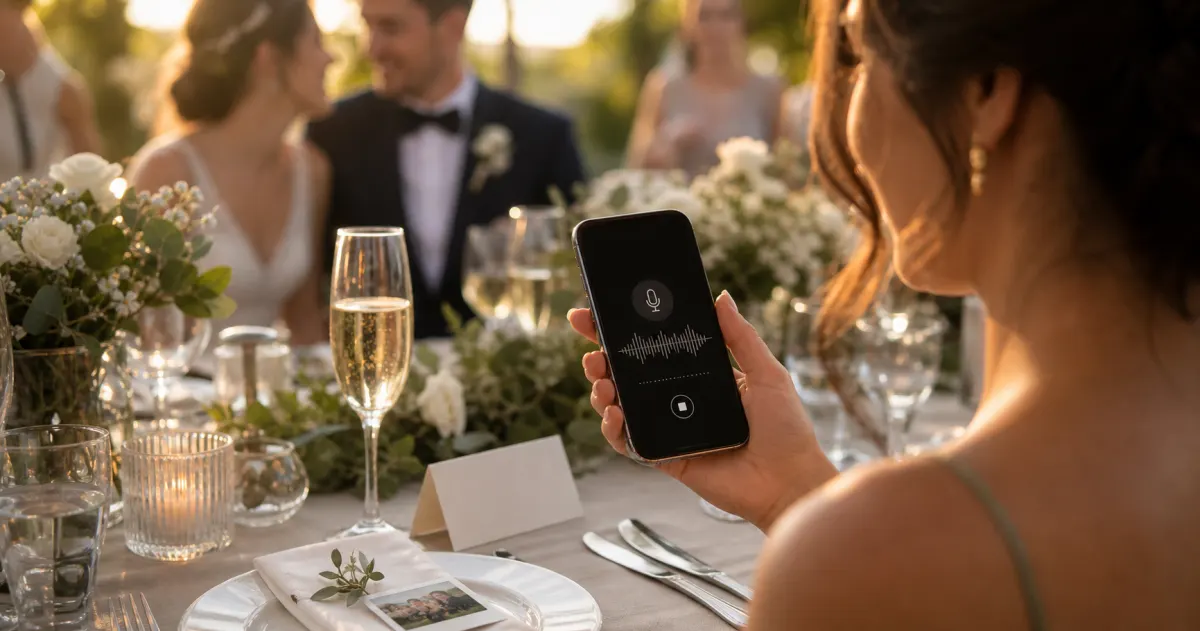
StoryThe most underrated wedding keepsake: guest voice messages
Guest voice messages are the wedding keepsake couples replay most -- real voices, real pauses, the things people said when they actually meant them.
 Ranking
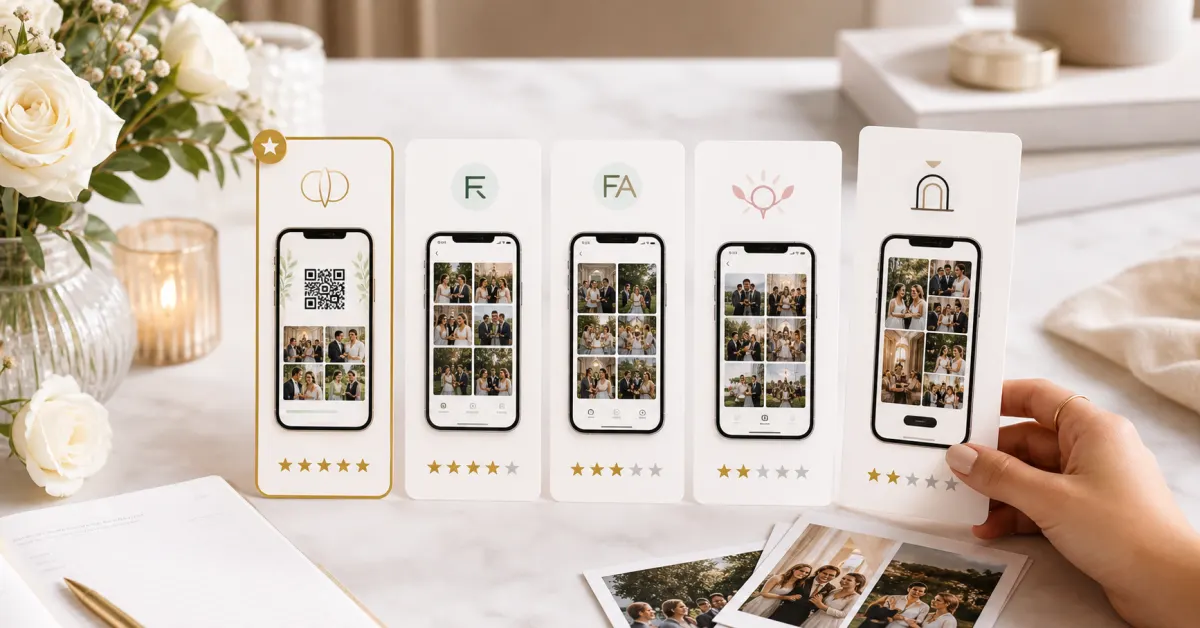
Best wedding guest photo apps of 2026
We compared the wedding guest photo apps couples actually use -- on price, friction, and what you keep afterward. Our ranked best-of for 2026.
 Guide
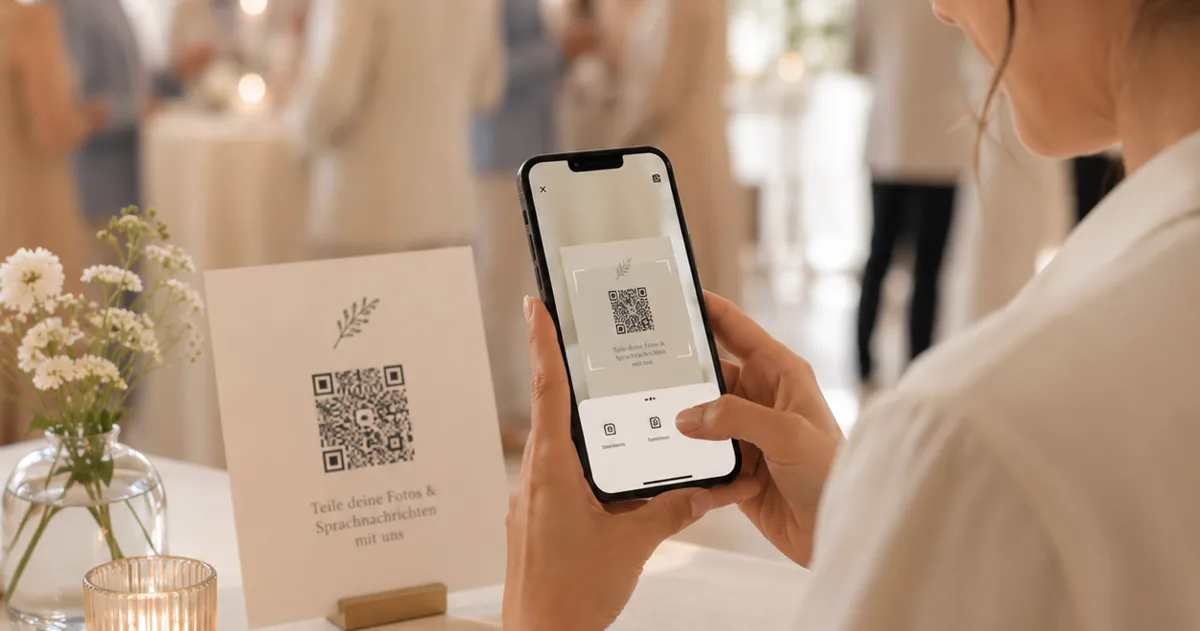
GuideAudio guestbook for weddings: skip the rental
An audio guestbook used to mean renting a retro phone for hundreds of euros. How to collect wedding voice messages with a QR code instead.