
You will not remember what your wedding looked like as clearly as you think. You will remember how it sounded — your dad's voice cracking halfway through the toast, your oldest friend laughing at the back of the room, your grandmother saying your name. And those are the exact things a photo can't hold.
That's the case for an audio guestbook. Not as a replacement for the photos — you want those too — but as the part of the day a photo wall was never built to keep. Below is why a wedding needs both, what an audio guestbook actually is, and how to set one up without a single piece of rented hardware.
What is a wedding audio guestbook?
A wedding audio guestbook is a way for your guests to leave you a spoken message — a memory, a wish, a story, a song — instead of (or alongside) a signature in a book. Where a traditional guestbook gives you a page of names, an audio guestbook gives you voices: the actual sound of the people who were there, saying something only they could say.
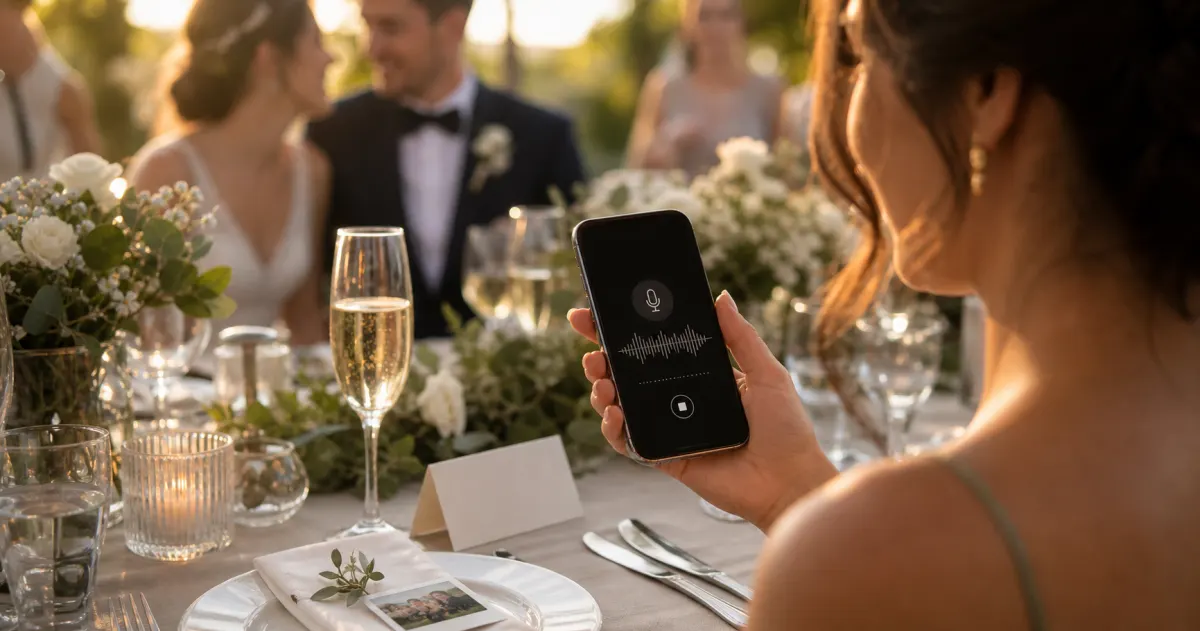
There are two ways to run one. The familiar version is a rented vintage telephone — guests lift the handset, wait for the beep, and record. It looks lovely on a side table, and the hardware-rental market has built a whole aesthetic around it. The newer version is software-only: guests scan a QR code, their phone opens a recorder in the browser, and they speak. No handset to hire, no booth to staff, no single point of failure if the line jams during the speeches.
Both capture the same precious thing. The difference is cost, logistics, and how many of your guests actually use it — which is where the photo-wall comparison comes in.
Photos capture the room. Voices capture the people.
A photo wall — guests scanning a QR code to upload pictures into one shared album — is genuinely worth having. Your photographer captured the formal frames; your guests captured the candid ones the photographer never saw. (We make the full case for that in our guide to collecting wedding guest photos.)
But here's the limit of a photo-only setup. Most of those images are never looked at again. Roughly 70% of camera-phone photos are never revisited, with only about 27.8% ever meaningfully looked at again, according to research summarised in Popsa's "Memory Economy" report. And the sheer volume keeps climbing — an estimated 1.9 trillion photos were taken worldwide in 2024 (Photutorial). A wedding adds hundreds more to a pile most people already drown in.
A voice message survives that pile, because it is rare. You might have ten thousand photos of yourself and one recording of your late grandfather telling you he's proud of you. Guess which one you'll play on your tenth anniversary.
That's the honest division of labour at a wedding:
- Photos show you what the day looked like — the dress, the light, the dance floor at midnight.
- Voices give you what the day felt like — the people, the words, the things said only out loud and only that once.
A photo wall does the first job beautifully and the second job not at all. That's not a flaw in the photo wall. It's just the reason you need both.
Why an audio guestbook beats the traditional guestbook book
The signed paper guestbook is a wedding tradition for a reason, but be honest about what it actually gives you afterwards: a column of names and a scattering of "Congrats!!" that all blur together. The handwriting is lovely. The content rarely is, because writing in a book at a wedding is awkward and rushed.
Speaking is different. People relax into a microphone in a way they tense up over a blank page. Given a moment alone with a recorder, guests tell stories — how they met you, the thing they've never told you, the advice they wish someone had given them. You get the same warmth a guestbook promises, but with the detail and the voice intact.
And unlike the book, an audio guestbook scales to people who aren't in the room. A relative who couldn't travel can still record a message from home and have it land in the same album as everyone at the reception.
Why software beats renting a phone
If you've priced a wedding audio guestbook, you've probably seen the rented-telephone option — a refurbished handset, a recording box, delivery, and pickup, all for a single day. It's charming. It's also a fixed cost for a fixed piece of hardware that one drink-spill or dead battery can take offline during the exact ten minutes you most wanted it working.
A software audio guestbook removes that fragility:
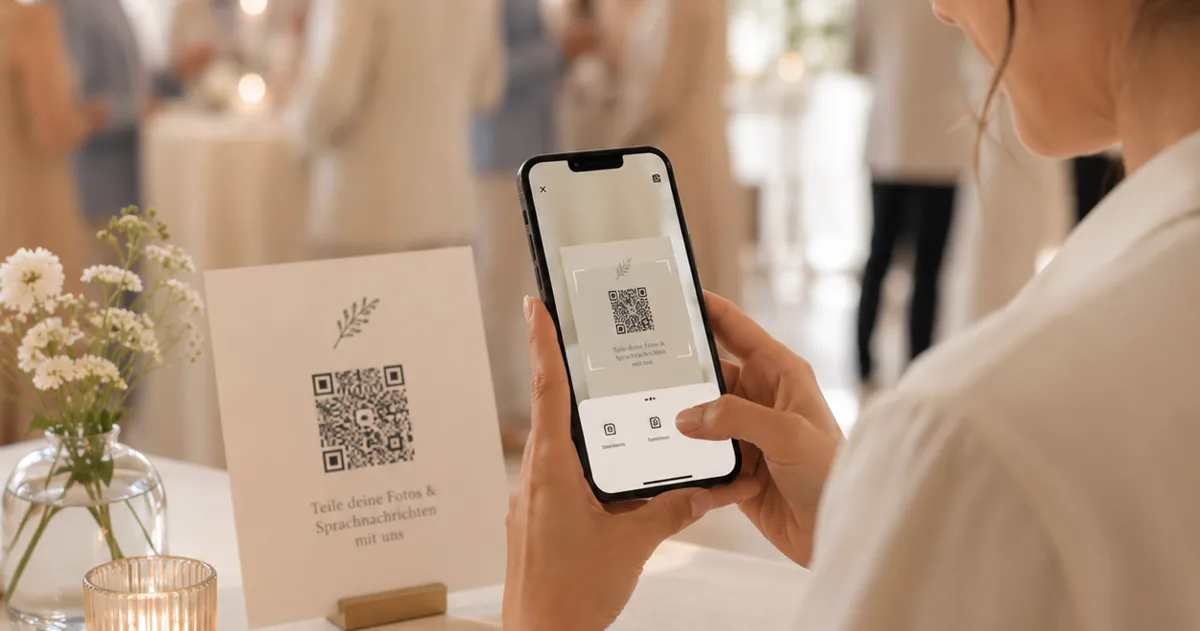
- No app, no signup for guests. With Gathmo, guests scan your wedding QR code or open your short link, and they're straight into the recorder in their phone's browser. There's nothing to download and no account to create. (Smartphone penetration in Germany is around 97%, per Statista — practically everyone in the room is holding the recorder already.)
- More than one person can record at once. A single rented handset is a queue. A QR code is not — twenty guests can be leaving messages at the same moment from twenty different tables.
- You're not limited to one room. The handset only works where it's plugged in. A link works from the ceremony, the garden, the after-party, and the guest who's at home with a newborn.
- The recordings come to you in the same album as the photos. No SD card to retrieve, no box to unplug and return. Voice messages land in a dedicated Voice Messages section of your Gathmo album, each with a waveform player you can scrub through.
With Gathmo, voice messages are included on every plan — even the free tier — with recording lengths 30 seconds on Free; unlimited on paid tiers on the Grand tier. On the Grand tier (and on our B2B plans), each message also comes with an automatic transcript, so you have the words written down as well as spoken — useful when you want to quote a message in a thank-you card, or simply read it on a day you can't quite bear to hear it yet.
A note on honesty: in-browser audio guestbooks are no longer unique — a handful of tools now offer them. What's still genuinely rare is the transcript. Among the wedding-photo tools we track, only one competitor (JoinMyMoment) transcribes voice messages at all (as of June 2026). Pricing and features change, so always re-check before you buy.
How to set up your wedding audio guestbook
You don't need a tech team for this. The flow is the same one your guests already use for the photo album:
- Create your wedding album. Set up your event and turn on the audio guestbook. Voice messages are on by default across Gathmo plans, so there's nothing exotic to enable.
- Get your QR code and short link. Gathmo generates both. The short link is handy for your wedding website and for guests who can't travel.
- Put the QR code where people pause. Table cards work best, because that's where guests sit with a free moment. For a seated card scanned from around 30–50 cm, print the QR code at roughly 3–5 cm, keep a clear blank margin (a "quiet zone") of at least four modules around it, and use dark-on-light for reliable scanning. For a larger A-frame or standing sign read from a metre or two away, size the code up to around 10–25 cm.
- Tell guests what to say. This matters more than any setting. A blank "leave a message" prompt freezes people; a specific one unlocks them. Put a short prompt on the sign — "Tell us how we met, or leave us a message for our tenth anniversary."
- Test-print and scan before the day. Print the sign at its real size and scan it from where guests will stand, under the actual lighting. A code that scans on your laptop can struggle on glossy card under warm reception lighting.
Prompt ideas that get guests talking
The best audio guestbook messages come from the best prompts. A few that reliably work:
- "Tell us your favourite memory of us — the one we don't know you remember."
- "What's one piece of marriage advice you'd give us?"
- "Sing the first ten seconds of a song that reminds you of us."
- "Leave a message for us to open on our tenth anniversary."
- "Say hello to our future kids."
Your guests' voices stay in Europe
Voice recordings are personal data, and a recording of your grandmother is about as personal as it gets. Gathmo stores every photo, video, and voice message on EU servers in Frankfurt, under GDPR, with data-processing agreements in place with our processors. Your album is private to you unless you choose to share it, and when it expires it's deleted — there's no silent archive. For couples in Germany, Austria, and France in particular, that's not a compliance footnote; it's the difference between memories you control and memories sitting on a server you've never heard of.
(Where competitors are concerned, EU data residency varies a lot — some are explicitly US-hosted, several are US-based with EU residency not confirmed, and a few German tools host in Germany. We keep an honest, regularly updated breakdown in our comparison on the hub.)