The Best Alternatives to a Physical Birthday Guestbook in 2026


You bought the book. It sat on the gift table, near the cake. And by the end of the night, it had four entries — three from the same family, one from a six-year-old who drew a dinosaur.
That is the quiet truth about the physical birthday guestbook. It looks lovely on the table. People walk past it. The pen runs out. And what you actually wanted — the voices, the faces, the in-jokes, the wish from the friend who couldn't fly in — never makes it onto the page.
So you start searching for a digital birthday guestbook alternative. Good instinct. But "digital" covers a lot of ground, from a phone in a box you rent for a weekend to an album that collects photos, video, and spoken wishes from everyone in the room. This guide walks through the real options, what each one is good for, and how to pick the one that fits your birthday — whether it's a kids' party, a milestone, or a surprise.
This is an honest guide, not legal advice. Verify any compliance-critical detail with the provider before you buy.
Why people give up on the paper guestbook
It's not that a blank book is a bad idea. It's that a birthday is a moving party, and a stationary book asks people to stop, sit, and write — at exactly the moment they'd rather be hugging the birthday person or grabbing cake.
Two things are working against the paper book:
- Most of the memory is on phones, not on paper. Around 1.9 trillion photos were taken worldwide in 2024 (Photutorial) — and a birthday is a small, intense burst of that. The candles go out, a dozen phones go up, and none of those shots ever reach the host. A paper book captures none of it.
- Most of what gets captured is never seen again. Roughly 70% of camera-phone photos are never revisited (Popsa, "The Memory Economy"). The photos exist; they're just scattered and forgotten. The job of a good guestbook in 2026 is to collect and resurface, not just to hold a few signatures.
A physical book records who showed up. A good digital alternative records what the day actually felt like.
The alternatives, ranked by how much they capture
Here are the realistic options, from "barely digital" to "captures the whole day." None of them is wrong — they just capture different amounts.
1. A prettier paper book (the low-effort upgrade)
Swap the plain book for a themed one — a photo-prompt book, a "fill in the blank" advice book, an instant-camera book where guests stick a Polaroid next to their note. It's tactile, it needs no Wi-Fi, and Grandpa can use it without a phone.
Best for: small, seated gatherings where everyone's at one table. The catch: it still only captures the people who sit down to write, and it still captures nothing from the friends who couldn't come. No photos from guests' phones, no voices, no faces in motion.
2. An audio guestbook phone (the rental)
You may have seen these at weddings: a vintage handset in a box. A guest picks it up, hears a prompt, and leaves a spoken message. It's charming, and a recorded voice beats a rushed signature every time.
The trade-off is that it's usually a rental — a physical device you hire for the day and ship back. Searches for "audio guestbook" are dominated by exactly this: phone, booth, rental, telephone, hire, stand (autocomplete data). That means a delivery window, a return, a deposit, and one device that one person uses at a time. It captures voices beautifully, but not photos, not video, and nothing from anyone who isn't physically standing next to the box.
Best for: a single venue, a fixed timeframe, and hosts who love the retro object itself. The catch: hardware to receive and return; voices only; remote guests are out.
3. A basic QR photo album (the digital minimum)
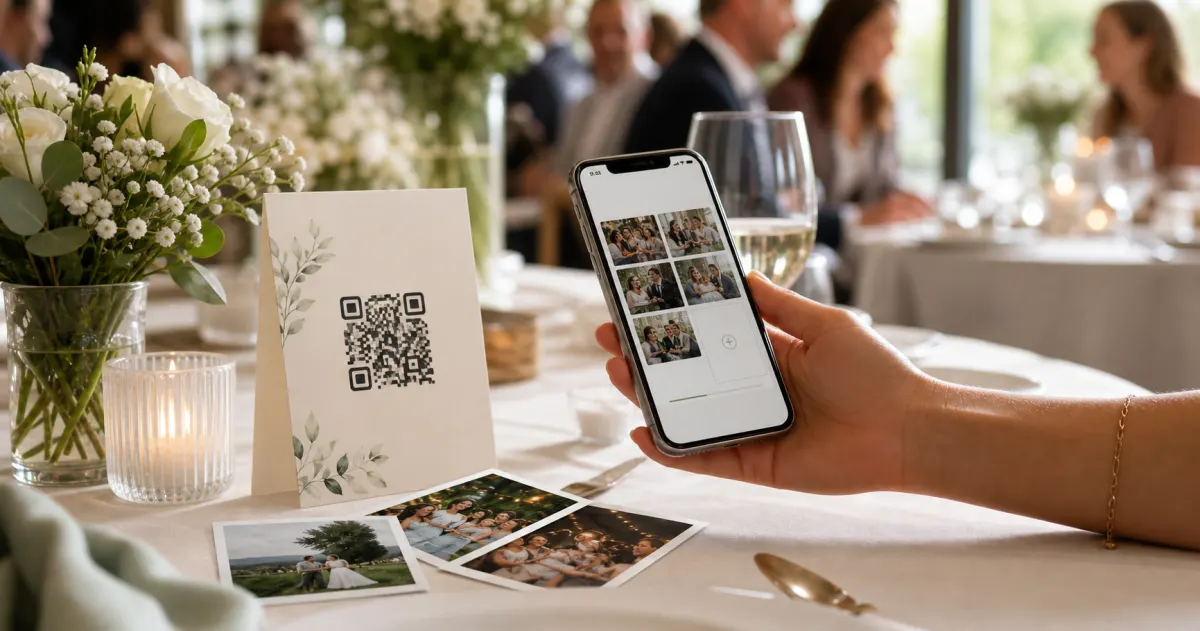
This is the big step up: print one QR code, put it on the table, and guests scan it and upload photos straight from their phone — no app, no signup. Suddenly you're collecting the day from every camera roll, not just the four people who wrote in the book.
Plenty of tools do this core job. Among the ones we checked on their own live pages (June 8, 2026): EventPics (free tier, then €4.99–€19.99/mo, EU-hosted), Kululu (free, then $39–$99 one-time), Rompolo ($19.99–$59.99 one-time), and LiveWall ($14.95–$49.95 one-time). They'll collect photos and usually video, and most let you download everything as a ZIP at the end.
Best for: hosts who mainly want the photos gathered in one place. The catch: a basic photo album isn't really a guestbook. A guestbook is about messages — voices and words, not just images. Most of these tools have no audio or voice guestbook at all (competitor data), so the "what people wanted to say" part is missing.
4. A full digital guestbook: photos, video, and spoken wishes in one album
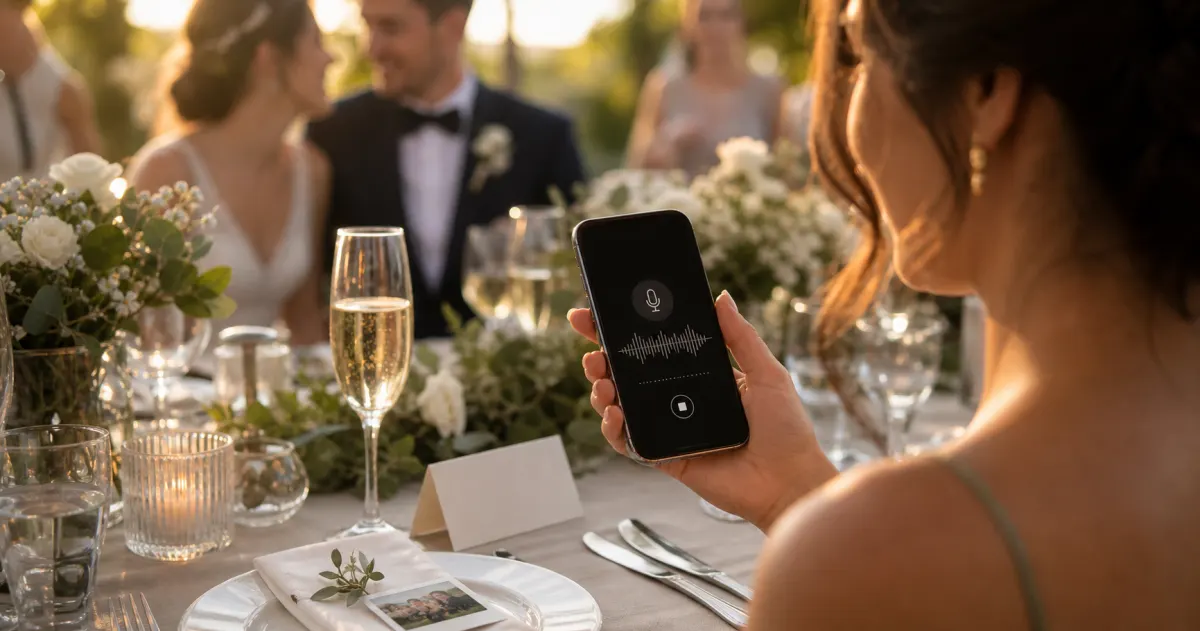
This is the closest digital replacement for what a paper guestbook was meant to be — except it captures far more than a paper book ever could. Guests scan one QR code or tap a link and can leave a photo, a video, or a recorded voice message, all into the same album, with no app and no account. The signatures become spoken wishes. The blank page becomes a gallery of the actual day.
This is the category Gathmo is built for. With Gathmo, guests scan and upload photos, video, and voice messages — no download, no signup. A few things make it a genuine guestbook rather than a photo dump:
- Voicemail is on every tier, 30 seconds on Free; unlimited on paid tiers. So even a free album collects spoken birthday wishes — the closest thing to a signature in someone's own voice.
- On the Grand tier, those voice messages come back with an automatic transcript you can read, print, and keep. A spoken wish becomes a readable one — handy if you want to mount the best lines somewhere, the way you'd have kept the book.
- Surprise Mode lets you collect pre-party wishes without the birthday person seeing the album before the reveal — the digital equivalent of everyone secretly signing the book behind their back.
- Remote guests are finally included. Anyone with the link can record a wish from their sofa in another country. A paper book on a table in Berlin can't do that; a link can.
Pricing is Free / €19 / €39 / €79 per event. Data is hosted in the EU (Frankfurt) — which, as we'll see, matters more than you'd think once children and grandparents are involved. Honest caveat: face-recognition photo search and RSVP aren't in the launch product — both are planned for a later phase. (source: 07-gathmo-product-facts.md)
Best for: any birthday where you want the whole day — photos, faces in motion, and voices — and you want people who couldn't attend to take part. The catch: it's a service, not a keepsake object on the table. If the physical book itself was the point, this won't scratch that itch (though nothing stops you printing the best photos and wishes afterward).
Quick comparison
| Alternative | Captures photos | Captures voice | Captures video | Remote guests | No app for guests | EU data |
|---|---|---|---|---|---|---|
| Prettier paper book | ❌ (Polaroids only, if any) | ❌ | ❌ | ❌ | n/a | n/a |
| Audio guestbook phone (rental) | ❌ | ✅ | ❌ | ❌ | n/a (hardware) | varies |
| Basic QR photo album | ✅ | usually ❌ | usually ✅ | ✅ | ✅ | varies by tool |
| Full digital guestbook (Gathmo) | ✅ | ✅ all tiers | ✅ 15 s → 600 s | ✅ | ✅ | ✅ EU (Frankfurt) |
(Competitor capabilities verified from each provider's own live pages on June 8, 2026. A basic photo album's "no voice" reflects that most photo-first tools don't offer an in-browser audio guestbook — check any specific tool before you buy.)
How to choose, by birthday type
The right alternative depends less on the tool and more on which birthday you're throwing.
Kids' party. You mostly want the photos — 22 parents' camera rolls in one place instead of "I have 40 shots and none from anyone else." A QR album does that. But if the children's images are going anywhere digital, where the data lives matters (see the next section), and a full guestbook lets the parents who couldn't make pickup still send a quick video hello. A paper book here is basically decoration.
Milestone birthday (40th, 50th, 60th, 70th+). This is the guestbook's home turf — and the one where a paper book disappoints most, because the whole point is the messages. Milestone birthdays draw outsized effort and spend (Party Genius AI, illustrative), and the people you most want to hear from are often the ones who couldn't travel. A full digital guestbook with voice and video wishes from near and far is the right call — and the transcript turns the best lines into something you can frame.
Surprise party. A rental phone box can't keep a secret, and a paper book gets discovered. You need to gather wishes before the reveal without the birthday person seeing them. That's exactly what Surprise Mode is for: collect pre-party messages, keep the album hidden, reveal it at the right moment.
Why "where the data lives" belongs in this decision
It feels odd to bring data residency into a birthday. But the moment you collect guests' photos and voices, you — the host — are the controller under the GDPR, and the app is your processor: a relationship that, by law, runs on a data-processing agreement setting out exactly what the app may do with that media (GDPR Art. 28(3)).
Two reasons this matters more at a birthday than at almost any other event:
- Children's data carries extra weight. Where a service is offered to a child, consent is only valid above a national age threshold — Germany keeps it at 16, Austria at 14 — and below that a parent must consent (GDPR Art. 8(1)). A kids' party is precisely where you want a host you trust and data you can locate.
- Anyone can ask for their clip to be deleted. A guest has the right to erasure, and the controller must act without undue delay, within one month of the request (GDPR Arts. 17(1), 12(3)). That's far simpler to honour when the media sits on EU infrastructure than in an undisclosed bucket somewhere.
Among the digital options, EventPics and Gathmo name EU hosting explicitly; several popular photo tools are US-hosted or don't say where their data lives (competitor data). A paper book, of course, keeps the data on your shelf — its one genuine privacy advantage, and a reason small, private gatherings sometimes stick with it. For everything bigger, choose a digital guestbook that keeps data in Europe and tells you where. (Cited to the GDPR; general information, not legal advice.)
Make the QR code actually work
A digital guestbook lives or dies on whether guests scan it. The good news: scanning is a normal habit now — 86.66% of UK and European smartphone users have scanned a QR code at least once, and over a third scan one most weeks (MobileIron / Ivanti). The friction you're picturing mostly isn't there. Three print basics so your sign works first time:
- Size it for the distance. A table card read from a seated 30–50 cm wants a code of roughly 3–5 cm; an A-frame read from a metre or two wants 10–25 cm. Rule of thumb: minimum code size is the scan distance divided by ten.
- Keep the quiet zone and the contrast. Leave a blank margin (about four modules) around the code, and use a dark code on a light background — not the reverse.
- Test-print before you make twenty. Print one at real size and scan it under the actual party lighting first.
Then drop that code where people already are: the cake table, the back of the invite, the WhatsApp group. (QR specs: 12-qr-print-best-practice.md.)
Frequently asked
It's an online album that collects messages and media from your guests — photos, video, and recorded voice wishes — usually via a QR code or link they scan and upload to from their own phone, with no app and no account. It replaces the blank paper book, and captures far more: voices, faces in motion, and wishes from people who couldn't attend.
For most birthdays, a full digital guestbook that collects photos, video, and voice wishes in one album is the closest replacement — because a real guestbook is about messages, not just pictures. Gathmo does this with voicemail on every tier and a Surprise Mode for hidden pre-party wishes. If you only want the photos gathered, a basic QR photo album is enough. If you love the retro object, an audio guestbook phone rental captures voices (but nothing else).
With the QR-album and full-guestbook options, no — guests scan a code or tap a link and upload straight from their phone browser. That's the whole point of a no-download guestbook. (An audio-phone rental is hardware, not an app, so there's nothing to install there either.)
Only with the digital options. Send them your album's link and they can record a video or voice wish from anywhere. A paper book on a table and a rented phone box both leave remote guests out. With Gathmo's Surprise Mode, those advance wishes stay hidden from the birthday person until the reveal.
Yes. Gathmo's Free tier collects photos, video, and 30-second voice messages with up to 100 uploads. Several photo-first tools also have free tiers, though most of those don't include a voice or audio guestbook — check before the party.
Absolutely. A digital guestbook doesn't cancel the keepsake — it feeds it. Download the album, print the best photos, and lay out the transcribed wishes (a Grand-tier feature) however you like. You get the keepsake and everything the paper book would have missed.
The strongest digital birthday guestbook alternatives in 2026 combine photo uploads, voice messages, and a frictionless guest experience. Gathmo's in-browser audio guestbook is the most complete option: guests scan a QR code, record a voice message (or upload a photo) with no app and no account required, and the message goes directly into the host's album — on every tier including free (30-second voice limit on free, unlimited on paid). Grand tier (79 EUR per event) adds automatic transcripts of every voice recording. For a milestone birthday, combining the photo album with voice messages produces a richer keepsake than text-only alternatives. The paper guestbook advantage — handwritten signatures — digital tools cannot replicate.
 Guide
GuideHow to collect photos from your event guests (the easy way)
A printed QR code on the table collects more photos than any link in a group chat -- here is why, and how to set one up in two minutes.
 Story
StoryThe most underrated wedding keepsake: guest voice messages
Guest voice messages are the wedding keepsake couples replay most -- real voices, real pauses, the things people said when they actually meant them.
 Guide
GuideCollecting guest photos in the EU without the GDPR headache
Consent, data residency, and erasure -- the three things that make event-media GDPR-compliant, and how to get them right by default.