How to Set Up AI Photo Moderation for Your Event in Under 5 Minutes


When you let guests upload photos to a shared album by scanning a QR code, you get the good stuff — the candid laughs, the dance floor, the toast nobody else caught. Occasionally you also get the blurry thumb shot, the accidental screenshot, or, at the wrong kind of party, something you'd rather wasn't on the big screen behind the cake. AI photo moderation is the quiet layer that catches that before it reaches your album or your live slideshow.
The good news: on a modern event platform, turning it on isn't a project. It's a setting. This guide walks through what AI moderation actually does, how to switch it on in Gathmo in under five minutes, and the questions worth asking any tool before you trust it with your guests' uploads.
Quick definition. "AI photo moderation" means an automated content check runs on every photo, video, and (where supported) voice message a guest uploads — flagging or holding anything that looks explicit, violent, or off — usually with a human review queue behind it for the edge cases a model isn't sure about. It is not face recognition. More on that distinction below, because it matters for both privacy and the law.
Why bother moderating an event album at all?
For a small family dinner, you probably don't need to. For anything bigger or more public, three reasons come up again and again:
- A live wall or slideshow is unforgiving. If uploads appear on a screen in real time, there's no "delete it before anyone sees" — moderation is the only thing standing between an upload and a room full of people. Festival and large-event uploads run into the thousands fast; for context, Coachella 2026 generated almost 40,000 posts across Instagram and TikTok (Visibrain). At that volume, no host is hand-checking every frame.
- QR-code uploads are genuinely frictionless — for everyone. That's the point of the format: 68% of consumers have used a QR code in the past year (TEAM LEWIS, 2024), and in Germany smartphone penetration is around 97% (Statista, 2024). Easy for guests means easy for the one guest who shouldn't have.
- You're often the legal "controller." Under the GDPR, the host who decides what happens to guests' photos is the data controller, and is expected to handle that data responsibly — including being able to act on a guest's request to take something down (more on that under the FAQ). Moderation is part of being able to say yes, we keep this clean.
Does AI moderation use face recognition? (No — and why that's the right answer)
This is the single most important thing to understand before you turn anything on, so let's be precise.
Content moderation and face recognition are different technologies that get lumped together. Moderation asks "is this image appropriate?" Face recognition asks "who is this person?" — and under EU law that second question is a much bigger deal. The GDPR treats a photo as ordinary personal data until it's "processed through a specific technical means allowing the unique identification ... of a natural person" (Recital 51) — at which point it becomes biometric data, and processing it to uniquely identify someone is prohibited unless you have an Art. 9(2) ground such as separate, explicit consent (GDPR Art. 9(1)).
In plain terms: an album that simply checks images for inappropriate content is on solid footing. An app that runs facial recognition to auto-tag guests has crossed into special-category data and needs explicit consent to do it.
Where Gathmo stands, honestly: Gathmo's moderation is content moderation, not face recognition. It pairs Hive for visual analysis with Whisper for audio, backed by a human review queue for anything the models flag as uncertain. Face-find / AI photo search is not a launch feature — it's on the Phase 2 roadmap, not in the product today. If a competitor's "AI" headline is really selfie-based photo finding, that's a different feature with different consent obligations, and you should treat it that way.
How to set up AI photo moderation in Gathmo (the 5-minute version)
Here's the whole thing, start to finish. You'll need a paid event — AI moderation is included on every paid tier (Essential €19, Celebrate €39, and Grand €79 per event), and on all B2B plans. The Free tier does not include AI moderation, so this is the one reason most public-facing hosts step up to Essential.
- Create your event (about 60 seconds). Set the date, name, and type. Gathmo generates your QR code and short link (gathmo.com/c/CODE) instantly.
- Pick a paid tier. Choose Essential, Celebrate, or Grand depending on guest count, retention, and whether you want a live slideshow (Celebrate and up) or a live stream (Grand). Moderation rides along on all three.
- Turn moderation on in the event's settings. It's a toggle. With it enabled, every uploaded photo and video is checked by Hive, and any voice message is checked via Whisper, before it's published to your album or pushed to a live screen.
- Decide what the queue does with a flag. Choose whether flagged items are held for your review or auto-rejected. For a live wall, holding-for-review is the safer default — nothing reaches the screen until it clears.
- Add a short upload notice for guests. Gathmo surfaces a guest-facing notice at the scan/upload point; keep it honest and plain (who runs the album, why, and that uploads are moderated). This is also where you cover the GDPR transparency basics — see the FAQ.
That's it. Print your QR code, place it, and you're moderated for the night.
One thing people miss: the QR code itself. Moderation only works if guests actually scan and upload. Size the code for where it lives — roughly 3–5 cm on a table card (seated, ~30–50 cm away) and 10–25 cm on an A-frame or standing poster (viewed from 1–2.5 m), following the 10:1 distance-to-size rule (minimum code size ≈ max scan distance ÷ 10) (Uniqode). Keep a 4-module quiet-zone margin, use dark-on-light contrast, and — always — test-print a proof and scan it under the actual venue lighting before you print the batch.
What AI moderation will and won't catch
Set expectations honestly with yourself before the event:
- It's very good at the obvious. Explicit, graphic, or clearly inappropriate images are exactly what these models are trained on. The human review queue is there to catch the genuinely ambiguous cases automation shouldn't decide alone.
- It is not a taste filter. A model won't know that Aunt Sandra hates unflattering photos of herself — that's still a human call, which is why the review queue and your own moderation matter.
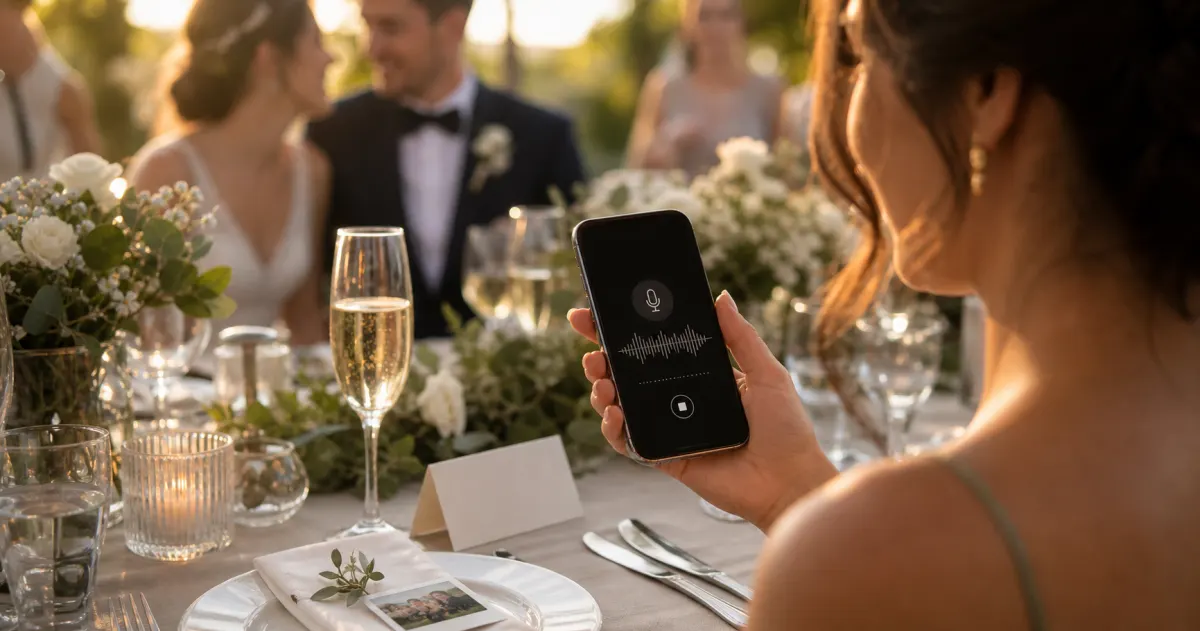
- Audio is checked too, where supported. Gathmo runs voice messages through Whisper, so a spoken guestbook gets the same attention as the photo stream — not something most competitors offer.
How Gathmo's moderation compares (verified June 2026)
Plenty of tools in this category don't offer real moderation at all; some offer it only on higher tiers; a few headline "AI" features that are actually something else. Here's an honest read of where things stand, with prices and features checked against each provider's own pages on 2026-06-08. Currencies are kept native, because today's exchange rate isn't tomorrow's.
| Tool | AI content moderation | Human review queue | Audio moderation | Notable caveat |
|---|---|---|---|---|
| Gathmo | ✅ included on all paid tiers (from €19/event) | ✅ | ✅ (Whisper) | Free tier has no moderation |
| Kululu | ✅ | not stated | ❌ (no audio guestbook) | US-hosted (Google Cloud); from $39 one-time |
| Fotify | ✅ | ✅ review queue | ❌ | US-hosted (Delaware LLC); from $29.99 one-time |
| Guestlense | ✅ | not stated | ❌ | EU residency not stated; from $49 one-time |
| LiveWall | ⚠️ partial | not stated | ❌ | EU/EEA-based (Norway, inferred); from $14.95 one-time |
| GuestCam | ❌ | — | — | US-hosted; from $49 one-time; offers selfie photo-find, not moderation |
| EventPics | ❌ | — | — | EU-hosted (Cloudflare R2 EU); from €4.99/mo |
(All competitor prices "as of June 2026." Tools marked "pricing on request" for their business tiers are written that way; we don't guess numbers.)
Two things stand out. First, audio moderation is rare — most tools that have an audio guestbook don't run any check over it, and most moderation-capable tools have no audio guestbook at all. Second, moderation and EU data residency rarely come together: Fotify and Guestlense have moderation but aren't EU-hosted (or don't say), while EventPics is EU-hosted but has no moderation. Gathmo's combination — AI + human-queue moderation, audio included, on data hosted in the EU (Frankfurt) with processor DPAs — is the part that's hard to assemble elsewhere. We won't claim it's the only EU option; we'll claim it's the most complete one we've verified.
Create your event and locate the moderation settings
In the Gathmo host dashboard, create or open your event and navigate to the Moderation section. AI moderation is active by default on all plans and automatically filters uploads for inappropriate content before they enter the album.
Choose your moderation mode
Select AI auto-approve (uploads that pass the AI filter go live immediately; flagged items are held for review) or Host must approve all (every upload requires a manual tap). For large events or sensitive venues, host approval gives maximum control.
Review flagged items from the dashboard
Flagged uploads appear in a separate queue in the dashboard. Tap to approve or remove each one. This typically takes seconds per item and is the only manual step in a moderated upload flow at most events.
Set up the dashboard on your phone before the event
Open the Gathmo dashboard on your phone before the event starts. You can review flagged uploads and approve photos in real time from anywhere in the venue without being tied to a laptop.
Frequently asked
For ordinary, non-biometric event photos, an event host (as controller) can generally rely on either consent (GDPR Art. 6(1)(a)) or legitimate interest (Art. 6(1)(f)), assessed by a balancing test. Consent is the safer basis where the balance is doubtful or where children are involved. Where you collect photos directly from guests, you must give them a clear information notice at the point of collection — who controls the data, why, on what basis, and their rights (Art. 13(1)). Moderation doesn't change the legal basis; it's about keeping content appropriate, not about lawfulness of processing.
Only as long as necessary for the purpose, with a defined retention period rather than indefinite storage (storage limitation and data minimisation, GDPR Art. 5(1)(e) and 5(1)(c)). Gathmo builds this in with tiered retention — for example 6 months on Essential, 1 year on Celebrate, and 2 years on Grand — after which the gallery is cleared.
Yes. A guest can exercise the right to erasure (GDPR Art. 17(1)) where a ground applies — for instance, the data are no longer needed or consent is withdrawn. You must respond without undue delay and in any event within one month, extendable by two further months for complex requests (Art. 12(3)). Practically, that means you need to be able to find and delete a specific item — which a managed album makes far easier than a group chat.
The check runs on upload, before an item is published. With "hold for review" set, flagged items wait for your decision rather than appearing on screen; everything clean flows through. For a live wall, holding-for-review is the safer default.
No — AI moderation is a paid feature in Gathmo, starting at Essential (€19 per event). The Free tier is great for a small private gathering, but if uploads are going on a screen or in front of a crowd, the paid tier is the one to choose.
AI photo moderation automatically scans incoming guest uploads for inappropriate content (NSFW images, offensive objects) before they appear on screen or in the shared album. It works as a first-pass filter: the upload enters the moderation queue, an AI classifier tags it as safe or flagged, and either approves it automatically (safe) or holds it for human review (flagged). The advantage over pure human moderation is speed -- AI processes each upload in under a second versus 10 to 30 seconds for manual review. The limitation: AI classifiers have false positives and false negatives. For a live photo wall at a corporate or public-facing event, AI moderation supplements human review rather than replacing it.
For a private closed album shared only with invited guests, AI moderation is not necessary. The guest pool is already trusted (invited individuals), the album is not public, and the upload volume is manageable for manual review. AI moderation adds value when: the album is semi-public (conference or trade show where anyone at the venue can scan), the expected upload volume is very high (hundreds of uploads within minutes), or the display is on a public screen where any upload appears immediately. For a wedding or birthday party with 50 to 150 guests and a private album, host approval for all uploads is sufficient and simpler.
 Guide
GuideHow to collect photos from your event guests (the easy way)
A printed QR code on the table collects more photos than any link in a group chat -- here is why, and how to set one up in two minutes.
 Guide
GuideCollecting guest photos in the EU without the GDPR headache
Consent, data residency, and erasure -- the three things that make event-media GDPR-compliant, and how to get them right by default.
 Story
StoryThe most underrated wedding keepsake: guest voice messages
Guest voice messages are the wedding keepsake couples replay most -- real voices, real pauses, the things people said when they actually meant them.