White-Label Event Photo Sharing: What Agencies Should Look for in 2026


If you run events for clients — as a planner, venue, production agency, or photographer — you've probably noticed the gap. Your clients want every guest photo, video, and voice note in one place, without an app and without the morning-after group-chat scramble. Plenty of tools do that. Almost none let you put your brand on it.
That's the difference between a consumer photo app and a genuine white-label platform. One asks your client to scan a code that says someone else's name. The other lets you sell the whole experience as your own — your domain, your logo, your client relationship — with the technology quietly invisible underneath.
This is a buyer's guide to that second category: what "white-label" actually means (it's an abused word), the checklist that separates a real reseller platform from a cosmetic logo swap, and an honest look at where the market stands in 2026 — including what Gathmo does and doesn't do yet. Every competitor price and feature below was verified from the provider's own pages on 2026-06-08; where pricing is quote-only, we say "pricing on request" rather than guess.
What "white-label" actually means (and what it usually doesn't)
The phrase gets stretched. In event photo-sharing tools, you'll see it cover everything from "upload your logo" to a full reseller programme with your own domain and API. Those are not the same product, and the gap matters when a client is looking at the screen.
It helps to think in three tiers:
- Cosmetic branding. You upload a logo and pick an accent colour, but the guest page still lives on the vendor's domain and the vendor's name is often still visible. This is what most consumer tools call "white-label." It's branding, not white-label.
- Branding removal. The vendor's name disappears, but you're still on their domain (e.g. vendor.com/your-event). Better — but the URL gives the game away.
- True white-label / reseller. Your custom domain, your brand on the guest page, the album, the QR code, the emails — ideally the SMS sender too. The client never sees the vendor. This is what an agency is actually buying when it wants to resell rather than recommend.
A quick test of any vendor's claim: ask what URL your client's guests will scan. If the answer contains the vendor's domain, it isn't true white-label, whatever the pricing page says.
The agency white-label checklist for 2026
Here's what to actually evaluate, roughly in order of how often it trips agencies up.
1. Custom domain, not just a custom logo
The single most important line item. Can guests land on photos.youragency.com (or your client's domain), or are you stuck on the vendor's subdomain? A custom domain is what makes the experience feel like yours — and it's the thing cosmetic-branding tools quietly don't offer. Gathmo provides custom domains from its entry Studio tier (one domain) and unlimited custom domains on Agency and Enterprise (custom domains run on Cloudflare for SaaS).
2. How deep the branding goes
A logo on the gallery is the easy part. The deeper checks are the email guests receive, the SMS sender ID, the QR landing page, and the album export. Gathmo's depth scales with tier: Studio is logo + accent colour; Agency is end-to-end branding; Enterprise is full branding plus a branded SMS sender. Branded email runs on Resend and the SMS sender on Bird — so the touchpoints your client's guests actually see can all carry your brand, not just the front page.
3. Per-event vs. subscription economics
Consumer tools sell one-time per-event licences — fine for a host throwing one party, awkward for an agency running fifty events a year. A reseller subscription changes the maths: you pay a flat monthly fee and run many events under it, keeping the margin between your client price and your platform cost. Gathmo's B2B tiers are subscriptions billed monthly or annually (annual = pay ten months, two free):
| Tier | Price (EUR) | Seats | Events/yr | Custom domains | White-label | API | SSO/SAML |
|---|---|---|---|---|---|---|---|
| Studio | €39/mo · €390/yr | 1 | 10 | 1 | logo + accent | ❌ | ❌ |
| Agency ★ | €99/mo · €990/yr | 5 | 50 | ∞ | end-to-end | ✅ | ❌ |
| Enterprise | from €399/mo · €3,990/yr | ∞ | ∞ | ∞ | full + branded SMS | ✅ | ✅ |
(Gathmo's own B2C per-event tiers — Free / €19 / €39 / €79 — are what your clients would pay if they bought direct; as a reseller you buy the subscription and set your own client price.)
4. Seats, events, and team access
If more than one person sets up events, count the seats: Studio is one, Agency includes five, Enterprise is unlimited. Match this to how your team works before the events-per-year cap or seat count bites mid-season.
5. API, and SSO for bigger clients
If you want event creation wired into your own booking or CRM flow, you need API access — Gathmo includes the API on Agency and Enterprise (not Studio), where most consumer-tier tools have none. And if you sell into large organisations, confirm single sign-on: Gathmo offers SSO/SAML on Enterprise only.
6. EU data residency and a signable DPA
For any EU client — and especially corporate ones — where the data physically sits is a procurement question, not a nice-to-have. Gathmo hosts in the EU (object storage in an EU jurisdiction on Cloudflare R2; the database in Frankfurt on Neon; compute in Frankfurt/Amsterdam on Fly.io) and signs Data Processing Agreements with its processors. We'll come back to the legal side below, because as the agency you sit in the middle of that chain.
7. The guest experience your brand is attached to
White-label is only worth selling if the underlying product is good, because your brand is on it. The non-negotiables in 2026: no app and no signup for guests (they scan a QR code and upload from any phone's browser), batch ZIP download of originals so your client gets everything, and content moderation so nothing embarrassing lands on a screen at a corporate event. Gathmo covers all three, plus an in-browser audio guestbook with transcripts on its top tiers and AI moderation with a human review queue.
How the market actually compares on white-label
The honest picture from the verified data: most event photo tools offer cosmetic branding, not true white-label, and the few that go deeper are either quote-only or not EU-hosted.
- Cosmetic only (logo / colour, vendor domain stays): GuestCam (white-label is a "Contact us" add-on, pricing on request), Kululu (a "Remove Kululu Branding" toggle), Fotify, Wedibox, EventShare, WedUploader, everlense. Good consumer tools; not reseller platforms.
- No white-label at all: EventPics, Qrowd Pics, Rompolo, FridaySnap. Some are otherwise strong — EventPics and FridaySnap are explicitly EU/Germany-hosted — but branding isn't on offer.
- True reseller depth, but caveats: Eventiere offers full reseller white-label with custom domains on its Professional/Enterprise plans, but pricing is on request and its EU data residency is only inferred (it operates mainly across the GCC, India, and the UK). memoryKPR offers white-labelled storefronts on its Business tier (from $199/mo, as of June 2026), but it's Canada-based with EU residency unknown. JoinMyMoment lists a B2B/reseller plan at pricing on request and is EU/EEA-hosted (sub-processors in Germany, France, AWS Frankfurt).
So the shortlist for "true white-label and EU data residency and a published reseller price" is short. That combination — custom domain, end-to-end branding, EU hosting, and a transparent monthly tier from €99 — is the niche Gathmo is built for.
One honesty note, because your clients will ask: Gathmo does not offer face-recognition photo search or RSVP at launch — both are on the roadmap (Phase 2), not in the product today. The competitor register records GuestCam and Eventiere with face-find capability as of 2026-06-08, so verify those tools directly if selfie-based photo finding is a hard requirement.
The legal piece agencies can't skip
When you resell an event photo platform you're usually in the data chain, and that has GDPR consequences. This is general information, not legal advice; check your own setup with a qualified advisor.
- Know who is controller and who is processor. Where one party processes personal data on another's documented instructions, GDPR requires a binding written Data Processing Agreement setting out the subject-matter, duration, nature, purpose, data types, and data-subject categories (Art. 28(3)). The vendor is typically the processor; your client (the host) is usually the controller. Depending on how you operate you may sit in between — so make sure the DPA chain actually reaches you. A vendor that can't produce a signable DPA is a problem you'll inherit.
- Tell guests at the point of collection. When data is collected directly from guests, the controller must provide defined information at that moment — who controls the data, the purposes, and the legal basis (Art. 13(1)). A good white-label product surfaces this notice on the scan/landing page under your client's brand.
- Honour deletion requests. A guest can ask for erasure, and the controller must act without undue delay and within one month, extendable by two further months for complex cases (Art. 17(1), Art. 12(3)). Confirm your platform makes per-guest deletion straightforward.
- Set a retention period and mind transfers. Personal data must not be kept longer than necessary (Art. 5(1)(e)) — auto-expiring galleries handle this. And sending guest data to a third country (e.g. a US-hosted vendor) is lawful only under an adequacy decision or safeguards such as Standard Contractual Clauses (Chapter V — Art. 45, Art. 46). Keeping data in the EU sidesteps most of that machinery — the practical reason EU residency keeps recurring on this checklist.
A note on the QR code your brand is printed on
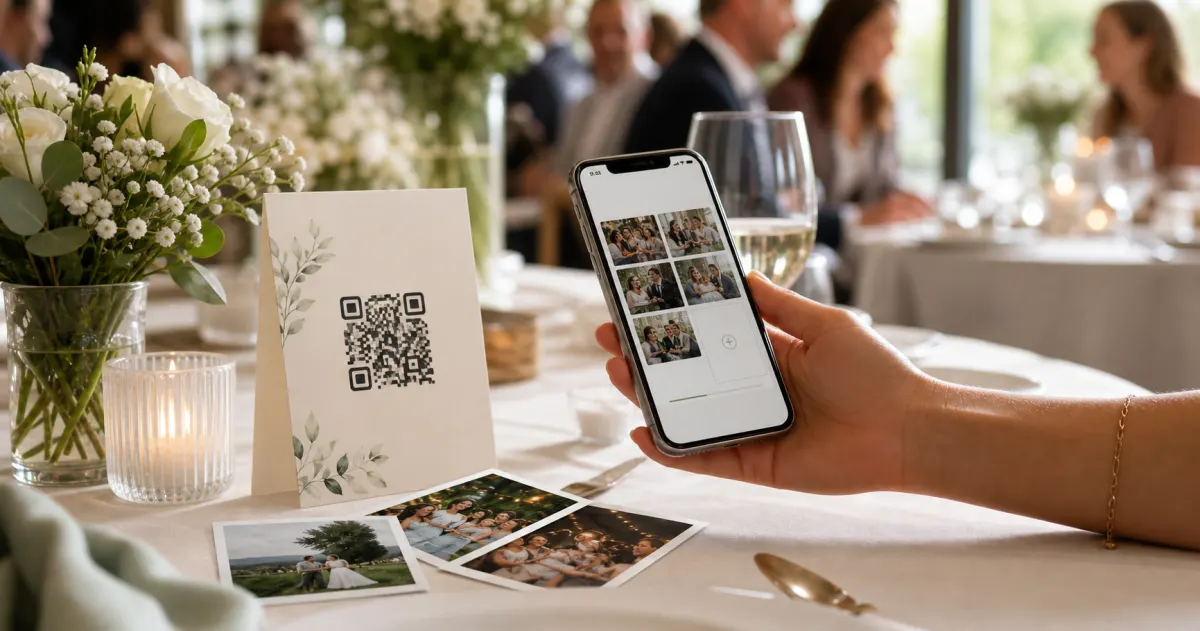
A QR code that won't scan quietly breaks an event. If you produce branded signage for clients, two specs to lock in: size for distance (a rule of thumb is minimum code size = maximum scan distance ÷ 10, so a table card read from ~30–50 cm wants a 3–5 cm code and an A-frame read from 1–2.5 m wants 10–25 cm), and — if you drop a logo into the centre — use error-correction Level H (~30% recovery) so the overlay doesn't kill scannability. Always test-print at the real size and scan it under the actual venue lighting first.
Choose a platform with true white-label capability
Verify the platform removes its own branding from the guest-facing upload page, the album URL, and any emails to guests. 'Powered by' footers and visible platform logos break the white-label experience. Request a demo before signing.
Sign the reseller agreement and confirm DPA structure
Ensure your reseller contract includes Art. 28 DPA provisions for your clients' events. As the reseller you act as a sub-processor; your clients are controllers. Each event should have a clear record of the data chain.
Set up each event under the client's branding
Create the event on the platform, upload the client's logo, set brand colours, and configure a custom subdomain if available. Create a test event first to confirm the branded guest flow looks correct before going live with a client.
Deliver branded albums as a productised service
Package the white-label album as a standard line item in your event proposals: Branded Guest Photo Album -- includes setup, branded QR signage, and post-event archive delivery. Clients purchase the experience, not the platform.
Frequently asked
At minimum, your client's guests should land on your (or your client's) own domain, with your brand on the gallery, the album, the QR code, and the emails — not the vendor's. Anything less is cosmetic branding. With Gathmo, end-to-end branding starts on the Agency tier (€99/mo), and a custom domain is available from Studio (€39/mo).
Yes — that's the point of a reseller subscription. You pay a flat monthly fee, run multiple events under it, and set your own client price. Gathmo's B2B tiers are built for this (Studio / Agency / Enterprise), with the API on Agency and above for wiring event creation into your own systems.
No. With Gathmo, guests scan a QR code and upload from their phone's browser — no app, no signup. That matters more than it sounds: smartphone penetration in Germany was forecast at around 97% in 2024 (Statista), and roughly 68% of consumers had used a QR code in the past year (TEAM LEWIS), so the scan-to-upload flow works for almost everyone without friction.
With Gathmo, yes — object storage in an EU jurisdiction, the database in Frankfurt, and compute in Frankfurt/Amsterdam, with DPAs in place. Note that "EU-hosted" is widely claimed; the useful question to ask any vendor is which data centre and whether they'll name it and sign a DPA.
Not at launch — face search and RSVP are on the roadmap (Phase 2), not in the current product. If selfie-based photo finding is a hard requirement, verify a face-find tool directly before promising it to a client.
Three revenue models: (1) Bundled into event packages -- the agency includes the photo experience as a deliverable priced as part of the event fee (e.g. 200 EUR for setup, QR card design, and gallery delivery); the platform cost is 39 to 79 EUR as a variable; (2) Upsell from basic to premium -- the agency offers a basic photo album at no additional charge, then upsells the live photo wall, audio guestbook, and branded gallery as premium add-ons; (3) White-label licensing -- the agency resells access to the platform under their own brand at a margin per event. Gathmo's B2B tier supports all three: custom branding, multi-event management, and agency-pricing structures.
The agency's GDPR position depends on their role. If the agency controls how guest data is processed, they are a controller and need their own privacy notice and DPA with the platform. If they process photos strictly on behalf of the client, the agency is a processor under Art. 28 and needs a DPA with the client. In practice, most event agencies operate as joint controllers or processors depending on the contract structure. Either way: use an EU-hosted platform (or one with SCCs), sign a DPA with the platform, and ensure the client takes responsibility for end-use (publishing, retention beyond the event). Consult your DPO or legal team for your specific situation.
 Guide
GuideHow to collect photos from your event guests (the easy way)
A printed QR code on the table collects more photos than any link in a group chat -- here is why, and how to set one up in two minutes.
 Guide
GuideCollecting guest photos in the EU without the GDPR headache
Consent, data residency, and erasure -- the three things that make event-media GDPR-compliant, and how to get them right by default.
 Story
StoryThe most underrated wedding keepsake: guest voice messages
Guest voice messages are the wedding keepsake couples replay most -- real voices, real pauses, the things people said when they actually meant them.