Company Offsite Photo Ideas: How to Capture Team Building Memories That Actually Get Shared

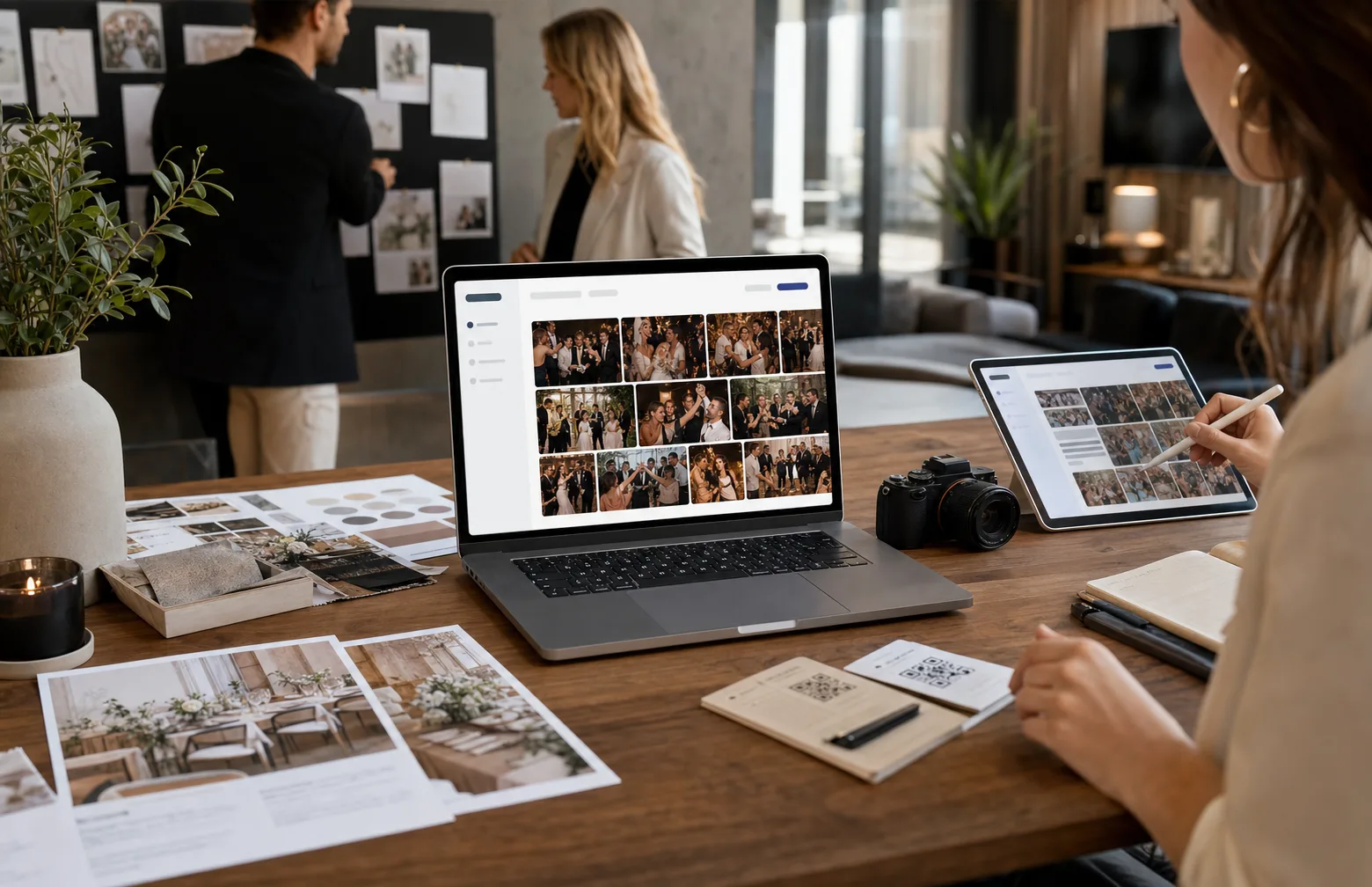
Here is the pattern almost every company offsite follows. The team spends two days hiking, cooking, problem-solving, or just escaping the office. Everyone takes photos. Everyone means to share them. And then the offsite ends, the inboxes refill, and the pictures vanish into three hundred individual camera rolls — never to be seen again.
That is not a small loss. The whole point of taking a team out of the building is the shared experience, and the photos are the only part of it that survives Monday — they show up in the next newsletter, on the wall by the kitchen, in the onboarding deck the new hire sees on day one. Lose them and the offsite becomes a line item nobody can picture.
This guide is about making sure the memories make it back to the office: specific photo ideas that suit a corporate offsite, paired with a practical way to collect everything in one place so the good shots actually get shared instead of stranded on phones. It is written for the HR managers, EAs, and internal-comms people who organise these days and then quietly become responsible for the photos afterwards.
Why offsite photos go missing (and why it matters)
Every fix below is aimed at one problem, so it is worth naming. Most photos people take are never looked at again — one analysis of the "memory economy" found that around 70% of camera-phone photos are never revisited. At an offsite, that plays out as a folder on each attendee's phone that nobody opens, least of all the colleagues who would enjoy seeing it.
The default fix — a group chat — quietly makes things worse. Group-chat fatigue is real and measurable: in one survey, 40% of respondents said they felt overwhelmed by group messages and notifications. A "share your offsite pics here!" thread starts strong, then becomes a wall of muted messages, and the photos sink below the noise within a week. The ones that do get collected often land somewhere no one can use — a personal Drive folder, an EA's laptop — so when internal comms asks for "a few good shots," tracking them down is an afternoon of polite begging.
The collection problem has a clean solution, and once it is in place, the creative ideas have somewhere to go. So let us start with the ideas, then come back to how you gather them.
Company offsite photo ideas that actually get shared
The best offsite photos are not the posed group shot at the end (though take that too). They are the candid, specific, slightly-unexpected images that make a colleague stop scrolling. Here are ideas that work for corporate teams without feeling forced.
1. The "arrival" shot — before anyone is tired. Capture the team at the start, when everyone is fresh and the location is new: the venue, the trailhead, the cooking studio, the coach. It sets the scene, makes a great opener for any recap, and gives remote colleagues a sense of "being there."
2. Activity-in-progress, not activity-completed. The trust fall mid-fall. The escape-room team frozen in panic. The kayak very obviously about to tip. Action shots taken during an activity carry the feeling of the day far better than the tidy "we did it!" photo afterward. Brief a couple of people on each team to shoot while others participate, then swap.
3. The candid working moment. Some of the most valued internal photos are not from the fun bits at all — the whiteboard session, a small group deep in a problem, two people laughing over a laptop. These read as authentic culture, which is exactly what internal comms and recruiting want, and they age well in next year's onboarding deck.
4. A "headshot corner" you set up on purpose. An offsite is a rare moment when the whole team is in good light, relaxed, and out of the fluorescent office. Set up a simple corner with decent natural light and let people grab a fresh profile photo for the intranet, Slack, or LinkedIn. It costs nothing, and people thank you months later when they need a current headshot.
5. The food, and "before and after" pairs. Shared meals are the social glue of an offsite, and food photos are the ones people reliably take anyway — the group dinner, the questionable team-cooked dish, the coffee break where the real conversations happened. Pair shots tell a story in two frames: the spotless 9am meeting room and the 5pm chaos, the clean hiking boots and the muddy ones, the blank flip-chart and the covered-in-ideas one.
6. The group shot — but make it a tradition. Take the whole-team photo, then turn it into something repeatable: same pose, same framing, every offsite. A year later you have a series that shows the team growing, and that recurring image becomes a small piece of company culture in its own right.
7. Let the voices in, not just the faces. A photo captures a moment; a voice captures a feeling. Some teams collect short spoken messages alongside the pictures — a quick "best moment of the day," or a one-line answer to a prompt like what surprised you about a colleague today? Played back later, these add a layer no photo can, and they fit a team-building day built around getting to know each other. (More on collecting these without a phone booth or rental hardware below.)
How to collect everything in one place
Good ideas die if there is no easy way to gather the results — and the collection method is the part most offsite write-ups skip. The bar to clear is low but specific: it has to be frictionless for every attendee (if it needs an app or a login, half the team won't bother), pull from everyone's phone (not just the one designated photographer), and land somewhere internal comms can actually use (one place, downloadable, not a chat thread).
The approach that meets all three is a single QR code that everyone scans to upload. Why it fits an offsite specifically:
- No app, no account. People are already half-checked-out; asking them to install software is a non-starter. A scan-and-upload link works on any phone, in the browser, with nothing to download — the only way you get the whole team rather than the keen 20%. (It rides on hardware everyone already has: smartphone penetration in markets like Germany is near-universal — around 97%.)
- Everyone contributes to one album. Instead of photos scattered across personal devices, everything lands in a single shared gallery. The shy photographer's best shot sits next to the team lead's, and nobody has to chase anyone.
- Voice notes work the same way. The "best moment of the day" idea above doesn't need a rented phone booth — a tool that accepts in-browser voice messages lets people record from the same screen they upload photos to.
Practically: you generate one code, put it where people will see it, and at the end download the whole album as a single file — then pull the dozen best shots for the newsletter, drop the album link in a wrap-up email, or feed images into next year's recruiting page.
A note on where you put the QR code
A code nobody scans collects nothing, so placement matters:
- On a welcome sign or agenda board: an A-frame or standing poster viewed from a metre or two wants a code around 10–25 cm; on a smaller A5 table stand, 4–7 cm is enough.
- On lanyards or printed agendas people hold: keep it at least 2 × 2 cm (2.5 × 2.5 cm is more comfortable at arm's length).
- Everywhere: leave the required quiet-zone margin, use a dark code on a light background (avoid inverting it), and test-print and scan a proof at the real size before printing a stack — a code that fails on glossy stock or under venue lighting quietly kills participation.
If your offsite spans multiple days or locations, a dynamic code (one whose destination you can manage) keeps a single printed code working throughout.
A quick, non-scary word on photographing employees
This is a corporate event, so it is worth one honest paragraph — not to alarm, just so it is handled. The moment a company collects and uses photos of identifiable employees for its own purposes (a newsletter, the intranet, recruiting), the GDPR applies. The practical, low-effort fix is transparency at the point of collection: tell people what the photos are for, who holds them, and how long they'll be kept. Article 13(1) of the GDPR asks for exactly that information when data is collected, and a QR upload page is a natural place to surface a short notice so it travels with the upload.
A couple of sensible habits make the rest easy: let opting out be genuinely consequence-free (in Germany, employee data has its own rules under BDSG § 26, and freely-given consent matters precisely because of the employer–employee dynamic), keep the photos in one managed place, and set a retention window rather than keeping them forever. None of this needs a lawyer for a normal team offsite — just a tool that lets you put a notice on the upload screen, control who sees what, and delete on request. We cover the full picture in our dedicated guide, GDPR and Employee Event Photos: What HR Needs to Know.
Not legal advice. This section is general guidance only. For your specific situation, check with your own data protection officer or counsel.
Where the tools stand (a quick, honest landscape)
Go looking for an offsite photo tool and you'll find a crowded market. A few honest observations, based on each provider's own public information as of June 2026:
- Most are built for weddings and parties first, and a chunk of them host data in the US — for example, GuestCam states US-based hosting with no EU option, and Kululu stores content on Google Cloud servers in the United States. For a one-off team day that may be fine; for a company that cares where employee photos sit, it is worth checking.
- A handful are EU-hosted, which matters more in a corporate context — EventPics (an Austrian company, billed monthly in EUR) and JoinMyMoment (EU/EEA hosting, sub-processors in Germany and France) both state EU residency explicitly.
- Voice messages are rarer than photos. An in-browser audio guestbook is not standard — only some tools offer it, and among the competitors surveyed, JoinMyMoment is the one that also transcribes recordings to text.
- "Free" usually means a small cap on guest count or how long the album stays up, so read the limits before relying on one for a whole team.
The point is not that any one tool is wrong — it is that "corporate offsite" has different requirements (data location, a notice on the upload page, one clean download) than "friend's birthday party," and consumer-grade options don't always meet them.
How Gathmo fits a company offsite
Gathmo is built for exactly the corporate-offsite job described above. Guests scan one QR code and upload photos, video, and voice messages straight from the browser — no app, no guest accounts — into a single branded gallery you control. At the end, you download the whole album in one go.
For an offsite specifically, a few things line up well:
- Everyone can join in seconds, which is the only way you get whole-team participation rather than a handful of contributors.
- Voice messages are available on every tier (with a transcript on the top per-event tier and on the business plans), so the "best moment of the day" idea works without any rental hardware.
- The gallery is yours, not ours — your logo and brand accent on the attendees' album, so it looks like a company artefact rather than a third-party app, which matters when it ends up in the newsletter.
- Data stays in the EU (object storage in the EU, primary database in Frankfurt), with a clear consent notice on the upload screen, defined retention windows rather than open-ended storage, and deletion on request — the corporate-appropriate posture for employee photos.
- It scales to the size of your day. A typical company offsite fits comfortably on the per-event Celebrate tier (€39, unlimited guests, with a live slideshow you can put on a screen at dinner); a small internal day can run on the Free tier to try it out.
To be straight about what it does not do: Gathmo does not offer facial-recognition photo search at launch (it is on the roadmap, not a live feature) — which, for a corporate event full of employees, is honestly one less compliance headache, not a gap.
Set up a shared photo album and share the link before the offsite
Create a Gathmo event in advance and include the album link in the offsite welcome email. Team members who arrive at different times can start uploading immediately without waiting for a briefing.
Assign an informal photo lead for each session
Ask one person per group or activity to be the photo lead for that segment. This distributes coverage across simultaneous activities without requiring a professional photographer.
Use the QR code at meals and social sessions
Place a QR table card at every meal table and in the social area. These unstructured moments produce the most candid photos worth keeping. Mention the album during the opening session so everyone knows it exists.
Share the album with the whole team after the offsite
Once uploads settle -- usually within 48 hours of returning -- send the Gathmo album link to the entire team. Members can browse what others captured, download their favourite photos, and contribute additional shots from the week after.
Frequently asked
Collect them into one shared album as people take them, rather than relying on a group chat afterward. A single QR code that everyone scans to upload — no app, no login — pulls photos from the whole team into one place you can then download and share, instead of leaving them stranded on individual phones.
Remove the friction. If contributing requires an app install or an account, most people won't bother. A browser-based scan-and-upload link, combined with putting the QR code somewhere everyone passes (welcome sign, agenda board, lanyards), gets participation from the whole team rather than just the designated photographer.
Action shots taken during activities (not the posed "we did it" after), candid working moments at the whiteboard, a casual headshot corner in good light, food and shared-meal photos, and "before and after" pairs. Short spoken voice notes — each person's "best moment of the day" — add a layer photos can't.
When a company uses photos of identifiable employees for its own purposes, the GDPR applies, so the safe habit is transparency at the point of collection (telling people what the photos are for) plus a genuinely consequence-free way to opt out. In Germany, employee data has specific rules under BDSG § 26. For anything published outward, treat clear, freely-given consent as the default. This is general guidance, not legal advice.
For a small internal day, a free tier can be a fine way to try the format. Just check the limits before you rely on it — free tiers usually cap guest numbers and how long the album stays available, and many consumer tools host data outside the EU, which matters more for employee photos than for a party.
A QR album solves this: instead of asking employees to send photos to a group chat or shared drive (which requires them to act after the event), a QR code on the offsite table cards lets them upload directly during the day. Photos go into a shared gallery that the company owns and downloads afterwards. Employees retain their own photos; the company gets a curated set without chasing files. This sidesteps the WhatsApp problem (compressed photos, no organised album) and the personal Google Drive problem (photos owned by whoever created the folder). Gathmo's B2B plans include a DPA and EU hosting, satisfying most corporate data governance requirements.
HR and communications teams consistently get the most reuse from: (1) candid team collaboration shots (people working together, not posed); (2) group shots with varied framing (room-wide, small-group, paired); (3) venue and setting shots that convey the experience; (4) reaction moments during presentations or activities (candid expressions are more engaging than staged smiles); (5) photos that incidentally show diversity across the team -- these are more reusable than those centred on a few faces. A QR album generates all of these simultaneously from many angles, which is why it supplements (not replaces) a designated photographer for the key formal moments.
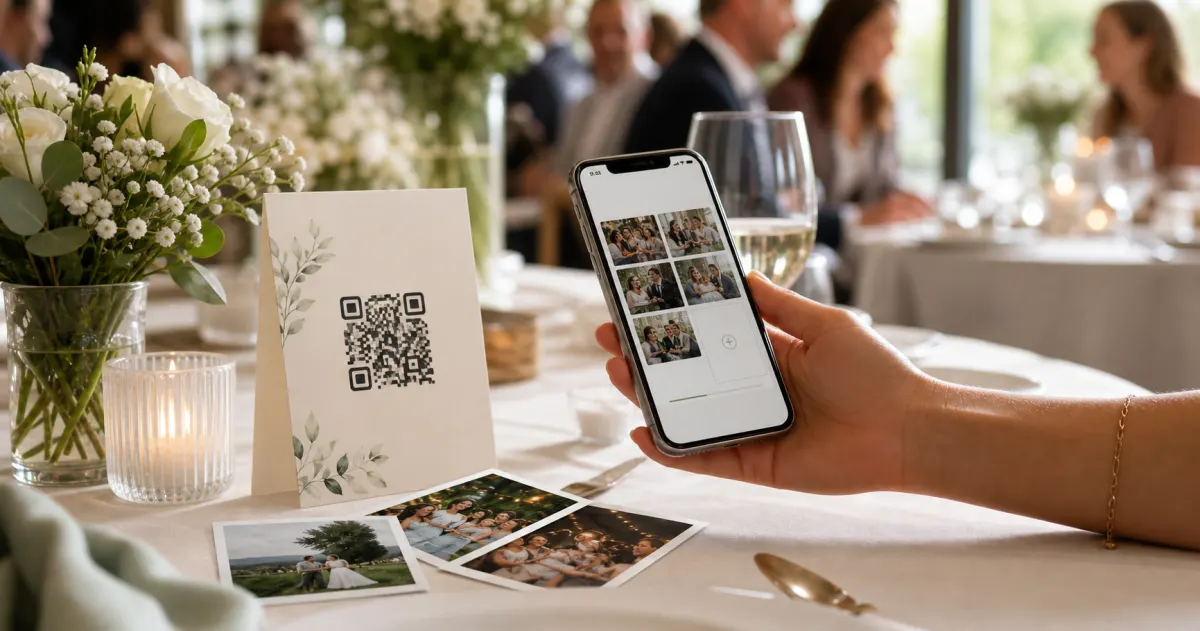 Guide
GuideHow to collect photos from your event guests (the easy way)
A printed QR code on the table collects more photos than any link in a group chat -- here is why, and how to set one up in two minutes.
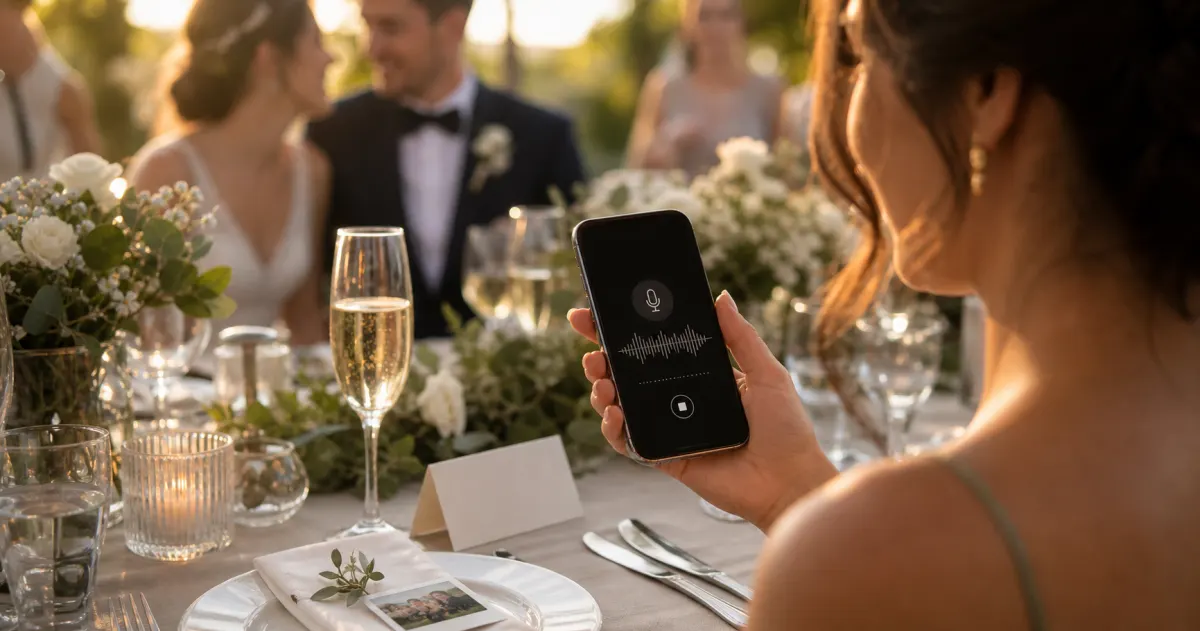 Story
StoryThe most underrated wedding keepsake: guest voice messages
Guest voice messages are the wedding keepsake couples replay most -- real voices, real pauses, the things people said when they actually meant them.
 Guide
GuideCollecting guest photos in the EU without the GDPR headache
Consent, data residency, and erasure -- the three things that make event-media GDPR-compliant, and how to get them right by default.