How Event Agencies Can Offer Branded Photo Experiences Without Building Their Own Tech


Your clients already expect you to handle the photographer, the AV, the stage, the signage, and the post-event recap. Increasingly, they also expect a guest-facing photo experience — a QR code on the lanyard, a live wall behind the keynote, a branded album in the follow-up email — and they expect it to carry their logo, not a tool's.
That expectation puts agencies in an awkward spot. Building photo-collection software in-house is a multi-quarter engineering project you have no reason to take on. Reselling a consumer app means a guest scans your client's QR code and lands on a page that says "Powered by SomeApp" — which is the opposite of what your client paid you for. And the moment a corporate client's legal team asks where the employee photos are stored, a US-hosted consumer tool becomes a deal you can't close.
There is a third option: white-label the infrastructure, brand the surface yourself, and resell it as your own. This guide explains how that works, what "white-label" actually means once you read past the marketing, and which capabilities a corporate buyer's procurement team will ask you to prove.
This article is general guidance for agencies, not legal advice. Where it touches GDPR, confirm specifics with your own counsel and your client's data protection officer.
What "branded photo experience" means to a corporate client
When an event agency says it offers a "branded photo experience," a corporate client hears three specific things — and a guest-grade tool usually fails at least one of them:
- Their brand, not yours, and definitely not a vendor's. The guest-facing upload page, the gallery, the album link, and ideally the domain in the address bar should read as the client's event — Acme Sales Kickoff, not "Acme via SomeApp."
- Control over what goes live. A 600-person conference cannot push every uploaded image straight to a public wall. Someone needs an approval queue, and ideally automated pre-screening, before a photo appears on the stage screen or in the shared album.
- A defensible answer on data. For an internal event full of identifiable employees, "where is this hosted, who is the processor, and can we get a Data Processing Agreement?" is not an edge case. It is the first question procurement asks, and a "no" ends the conversation.
The agencies that win this work are the ones who can say yes to all three without writing a line of code — because they are reselling infrastructure that already does it.
Build it, resell a consumer app, or white-label: the three options
Option 1 — Build your own
A genuinely custom platform means uploads, transcoding, storage, moderation, a gallery, export, EU data handling, and the security posture to survive a corporate vendor review. That is a software product, not a feature — for almost every agency, the build and maintenance burden makes it the wrong call.
Option 2 — Resell a consumer photo app
Fast to start, but it breaks on the two things corporate clients care about most. Most consumer event-photo tools offer only cosmetic branding — a logo upload and a colour swap — while the guest still lands on the vendor's domain and sees the vendor's name. And most are not built for EU corporate procurement. In our June 2026 review of the consumer event-photo market, the large majority of tools were US-hosted or did not disclose where data is stored at all, and offered no Data Processing Agreement. You can resell them, but you cannot truthfully present them as your own product to a compliance-gated buyer.
Option 3 — White-label the infrastructure
You take a platform built to be resold, put your brand (or your client's) on every surface, run the event from a multi-client workspace, and your client never sees the underlying vendor. This is the model that lets an agency offer a "branded photo experience" as a line item — and the rest of this guide is about doing it well.
What real white-label means (and what's just a logo swap)
"White-label" is the most over-claimed phrase in this category, so it pays to define the levels precisely. When you evaluate a platform, sort every claim into one of these:
| Level | What it actually is | What the guest sees |
|---|---|---|
| Cosmetic branding | Logo upload + accent colour on the vendor's page | Vendor's domain, often the vendor's name |
| Branding removal | A "remove [vendor] branding" toggle | Vendor's domain, no vendor name |
| End-to-end white-label | Custom domain + branded email + branded SMS sender, vendor invisible | Your (or your client's) domain and brand, top to bottom |
| Full reseller | All of the above, packaged for you to sell under your own brand, with multi-client setup | Entirely your brand; the vendor is invisible infrastructure |
The honest state of the market in June 2026: among the consumer-facing event-photo tools we reviewed, true full-reseller white-label is rare — only a couple offered it, and both are based outside the EU, which reintroduces the data-residency problem for European corporate work. Most "white-label" claims in this category top out at cosmetic branding or a branding-removal toggle. When a platform says "white-label," your job as the reseller is to ask exactly one question: does the guest ever see a domain or a name that isn't ours? If the answer is yes, it is not end-to-end.
How Gathmo lets agencies resell a branded experience
Gathmo is built for exactly this: the guest scans a QR code, uploads photos, video, and voice messages in the browser — no app install, no guest account — and everything lands in a moderated, branded album. Under the hood it is the same product across every Gathmo vertical; on the corporate side, that capability is packaged for resale.
The reseller tiers (B2B subscription, billed monthly or annually — annual is paid as 10 months, so two months are free):
| Tier | Price (as of June 2026) | Seats | Events / yr | Custom domains | White-label depth | API | SSO/SAML |
|---|---|---|---|---|---|---|---|
| Studio | €39 / mo | 1 | 10 | 1 | Logo + accent | ❌ | ❌ |
| Agency ★ | €99 / mo | 5 | 50 | unlimited | End-to-end | ✅ | ❌ |
| Enterprise | from €399 / mo | unlimited | unlimited | unlimited | Full + branded SMS | ✅ | ✅ |
★ The Agency tier is the typical fit for an event company running events for multiple clients.
What "end-to-end white-label" means here in concrete terms: a custom domain so the guest-facing experience runs on your client's URL (Cloudflare for SaaS), branded email for the album and notifications (Resend), and on Enterprise a branded SMS sender (Bird). Studio gives you logo-and-accent branding on a single custom domain; Agency unlocks unlimited custom domains and end-to-end white-label plus API access; Enterprise adds full white-label with SSO/SAML and the branded SMS sender. The practical effect: you set up one client per workspace, point a domain, drop in their logo and brand colour, and the event reads as theirs.
Two capabilities matter specifically for the corporate buyers your agency is pitching:
- Moderation before anything goes live. Every upload can pass through AI pre-screening (Hive for images, Whisper for audio) and a human approval queue before it appears in the album or on a live wall. For a brand-sensitive corporate event, that "nothing publishes until we approve it" guarantee is often the difference between a yes and a no.
- EU data residency you can actually point to. Gathmo stores media in an EU jurisdiction (Cloudflare R2 EU), runs its database in Frankfurt (Neon), and operates compute in the EU (Fly.io, Frankfurt/Amsterdam), with Data Processing Agreements in place with its processors. When your client's procurement team asks where the data lives, you have a named answer rather than a shrug.
A note on what Gathmo does not do at launch, because telling a client a feature exists when it doesn't is how an agency loses an account: face-recognition photo search and RSVP are not in the launch product — both are on the roadmap for a later phase. If a client's brief specifically requires selfie-based photo finding today, set that expectation up front.
The compliance layer your client's procurement team will ask about
This is where corporate event work diverges hardest from consumer event work, and where an agency that understands the rules looks dramatically more credible than one that doesn't. You don't need to be a lawyer — you need to know which questions are coming.
Who is the controller and who is the processor? When your client collects photos of their own employees and guests at their event, the client is typically the controller. The photo platform processing that media on the client's documented instructions is the processor. Under the GDPR, that relationship must be governed by a written contract — a Data Processing Agreement — and Article 28(3) sets out what it must contain: the subject matter and duration of processing, its nature and purpose, the types of data and categories of data subjects, and binding obligations on the processor (processing only on documented instructions, confidentiality, security measures, sub-processor conditions, assistance with data-subject requests, and deletion or return of the data at the end of the service). The practical takeaway for you as the reseller: confirm a DPA is available before you pitch, because your client's legal team will require one. (GDPR Art. 28(3))
What's the lawful basis for the photos? A corporate host needs an Article 6 lawful basis to process guests' images. For ordinary, non-special-category event photos a host can often rely on legitimate interest (Art. 6(1)(f)), assessed through a balancing test — but consent (Art. 6(1)(a)) is the safer basis where that balance fails. In Germany specifically, employee photos at company events are an awkward fit for "necessity" under BDSG § 26, so freely-given, documented consent — with a genuine right to refuse without disadvantage — is typically the right route. A platform that captures consent at the point of upload makes this much easier to operationalise. (GDPR Art. 6(1)(a) and 6(1)(f); BDSG § 26(1))
Are the photos "biometric data"? Only if they're processed by a specific technical means for unique identification — i.e. facial-recognition feature extraction. Recital 51 is explicit that merely storing and displaying photographs is not automatically special-category processing. This is precisely why a platform without face-recognition at launch is, in a strict sense, simpler to clear through compliance: ordinary galleries don't trigger the Article 9 regime that face-matching does. (GDPR Recital 51; Art. 9(1))
Can guests get their photos deleted, and how fast? A data subject can require erasure under Article 17, and the controller must respond without undue delay and in any event within one month of the request (extendable by two further months for complex or high-volume cases under Art. 12(3)). For you, this means the platform you resell needs a workable deletion mechanism — your client inherits the one-month clock. (GDPR Art. 17(1); Art. 12(3))
Knowing these four points cold is part of the product you're selling. The agency that can name the controller/processor split and point to a ready DPA closes faster than the one that has to "check with the vendor."
Branding the physical touchpoint: the QR code at the event
The branded experience starts before the upload — at the QR code your guests scan. A few specifications worth getting right, because a code that fails to scan undoes the whole experience:
- Use a dynamic QR code for event materials. Dynamic codes let you change or fix the destination after printing, which matters when artwork goes to print weeks before the event. (QR best-practice CITE-20260608-3018)
- Size it to the scan distance using the 10:1 rule — the code's minimum dimension should be roughly the maximum scan distance divided by ten. In practice: 2–2.5 cm on a lanyard or badge, 3–5 cm on a table card, and 8–12 inches on a stage banner viewed from across the room. (CITE-20260608-3001, -3011, -3012, -3015)
- Keep a quiet zone — a clear margin of at least four modules on all four sides, per ISO/IEC 18004 — and use a dark code on a light background. Avoid inverted (light-on-dark) codes; many scanners struggle with them, which is a real risk on a dark-themed stage banner. (CITE-20260608-3003, -3006, -3007)
- If you overlay your client's logo on the code, switch to error-correction Level H (~30% recovery) so the logo doesn't break the scan. (CITE-20260608-3010)
- Test-print and scan the proof at the final size, under the actual lighting and on the actual material, before the full run. A code that scans on your monitor can fail on glossy stock. (CITE-20260608-3019, -3020)
Present branded photo albums as a standard service line
Add QR-based photo collection as a deliverable alongside photography and AV. The pitch: guests' own photos collected in a branded album, available to the client within 48 hours, at a fraction of the cost of extended photographer time.
White-label the guest-facing pages with client branding
On Gathmo's reseller plan, upload the client's logo and set the brand colour. Guests see the client's branding throughout the upload flow, not Gathmo's. The album URL can also be customised to the client's domain.
Set up the event and hand over dashboard access
Create the Gathmo event, configure settings, and give the client view-only or full dashboard access. They can monitor uploads in real time during the event without requiring you to be on-site.
Deliver the archive and participation report
After the event, download the ZIP archive and provide it alongside an upload count and participation summary. This is the standard post-event handoff: a client-owned photo archive ready for reports, social posts, and press packs.
Frequently asked
Yes — with Gathmo, a guest scans the QR code, the upload page opens in their phone browser, and they upload photos, video, or a voice message. No app install and no guest account, which is exactly what you want for a one-time conference audience that won't download anything.
Create the event in your workspace, apply your client's logo and brand colour, point the custom domain (Agency tier and up), print a dynamic QR code sized for where it'll be placed, and decide your moderation policy — whether uploads auto-publish or wait in an approval queue. The album and engagement export are available afterward as a single download.
The platform can be — but compliance is a shared responsibility. Your client (as controller) needs a lawful basis and must handle data-subject requests; the platform (as processor) needs a DPA, EU-appropriate hosting, and a consent-capture and deletion mechanism. Gathmo provides EU data residency and a DPA; the lawful-basis and consent decisions sit with your client. This is general guidance, not legal advice.
Yes. The reseller tiers are built around event volume and multiple custom domains — Agency covers up to 50 events a year across unlimited custom domains, so you set up one branded environment per client.
As a subscription. Studio is €39/mo (10 events/yr), Agency is €99/mo (50 events/yr), and Enterprise starts from €399/mo (unlimited), all as of June 2026. Annual billing is charged as ten months, so two months are effectively free.
Three common pricing models: (1) per-event bundle -- the agency wraps the platform cost (e.g. Gathmo's 39 or 79 EUR per event) into a fixed project fee, typically 150 to 500 EUR for setup, QR card design, on-site support, and gallery delivery; (2) monthly retainer for regular clients -- the agency runs a B2B or reseller plan and bills the platform cost pro-rata; (3) per-event pass-through -- the agency charges the platform cost at cost or a small margin, with the agency fee for creative and management billed separately. The agency's margin comes from the setup, creative, and management work, not the platform cost alone.
A photo booth is hardware: a physical enclosure with a camera, lighting, and a printer, typically costing 800 to 2,500 EUR to hire for a day. It produces high-quality, branded prints on-site but requires vendor setup and takes up physical space. A QR photo sharing experience is software: guests upload from their own phones via a QR code, with the photo wall on screen. It costs 39 to 79 EUR on Gathmo (Celebrate or Grand tier) plus agency setup time. The QR approach produces more uploads (every guest has a camera), no on-site vendor, and a digital album the client keeps. The photo booth produces higher-production prints. Many agencies now offer both: the QR album for volume, the photo booth for keepsake prints.
 Guide
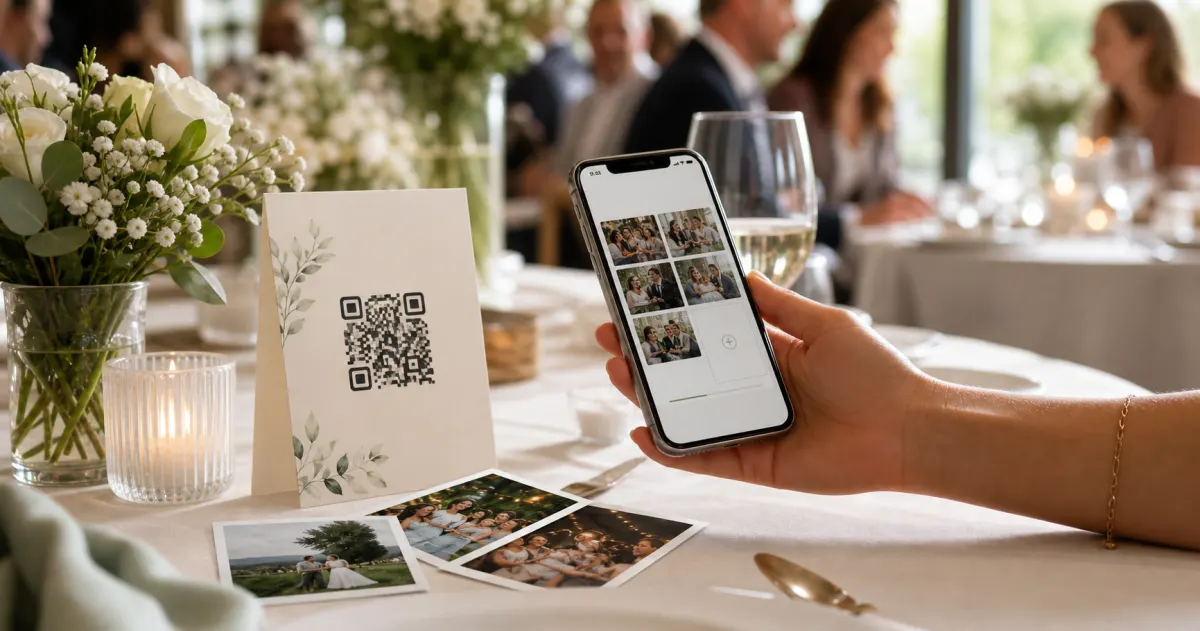
GuideHow to collect photos from your event guests (the easy way)
A printed QR code on the table collects more photos than any link in a group chat -- here is why, and how to set one up in two minutes.
 Story
StoryThe most underrated wedding keepsake: guest voice messages
Guest voice messages are the wedding keepsake couples replay most -- real voices, real pauses, the things people said when they actually meant them.
 Guide
GuideCollecting guest photos in the EU without the GDPR headache
Consent, data residency, and erasure -- the three things that make event-media GDPR-compliant, and how to get them right by default.