How to Measure Guest Engagement at a Corporate Event (With Photo Participation as a Metric)


You signed off the budget. You booked the venue, the catering, the AV crew, the keynote speaker. The event ran. People showed up, the room felt busy, the post-event survey came back broadly positive — and now someone on the leadership team asks the one question that always lands after the invoices: did it work?
"It felt great" is not an answer a procurement-minded organisation can act on. "We had 312 attendees" is a headcount, not an engagement figure — a full room of people checking email is not the same as a full room of people taking part. What you actually need is a small set of measurable signals that tell you whether the people in the room were involved, captured during the event itself rather than reconstructed from memory two weeks later.
This guide lays out a practical framework for measuring guest engagement at a corporate event, and makes the case for one underused, low-effort, leading-indicator metric most organisers ignore: photo participation — the share of your attendees who actively contributed media during the event. It is one of the few engagement signals you can collect passively, in real time, without sending a single follow-up message.
A note on scope: this is a measurement guide, not legal advice. Where we touch GDPR, we cite the regulation; for anything binding, run it past your own DPO or counsel.
Why "guest engagement" is hard to measure at corporate events
Engagement is one of those words everyone uses and few define. At a corporate event it usually collapses into one of three things that are easy to confuse:
- Attendance — did they register, and did they turn up? Easy to count, weakly correlated with value. A registration is an intention; a badge scan is a body in a room.
- Satisfaction — did they enjoy it? Captured after the fact via survey, skewed by who bothers to respond, and prone to the halo of a good lunch.
- Engagement — did they actively participate? This is the one that matters and the one almost nobody measures, because the obvious methods are either intrusive, manual, or both.
The stakes are not trivial. Engagement at work is one of the most heavily studied links to business performance there is: Gallup's Q12 meta-analysis — drawn from 736 studies across 347 organisations, covering 183,806 business units and more than 3.3 million employees — found that business units in the top quartile for engagement outperform the bottom quartile by 23% in profitability, 18% in productivity (sales), and 14% in productivity (production records and evaluations) (Gallup, Q12 Meta-Analysis, 11th edition, 2024). Internal events are one of the levers organisations pull to build that engagement. If you are going to spend on them, you should be able to measure whether the room was actually in it.
The problem is that the richest engagement signals have historically been the hardest to capture. You can station a person with a clipboard. You can run live polls and count responses. You can — and this is where it gets uncomfortable — deploy face-recognition cameras to track dwell time and "attention." That last option is not just heavy-handed; under EU law it crosses a bright line we will come back to. The good news is that one of the strongest leading indicators is also one of the cheapest to collect, and it sits in your guests' pockets already.
Photo participation as an engagement metric
Here is the underused idea: the percentage of your attendees who voluntarily upload a photo, video, or voice message during the event is a clean, real-time proxy for active participation.
Think about what it takes for a guest to contribute media. They have to be present, paying enough attention to notice something worth capturing, motivated enough to point a phone at it, and comfortable enough with the experience to share it. A bored attendee does not upload. A disengaged room produces silence. Photo participation is, in effect, a vote with the camera — and unlike a satisfaction survey, it is cast during the moment, not remembered afterwards.
It also avoids the two big failure modes of other engagement signals. It is not retrospective, so it does not depend on who fills in the form. And — done correctly — it does not require you to surveil anyone, because you are counting voluntary contributions, not tracking faces or movement.
Why does this work in practice now, when it might not have a decade ago? Because the friction is gone. QR codes have reached genuine mainstream adoption — 68% of US consumers report having used a QR code in the past year (TEAM LEWIS, Consumer Perceptions of QR Codes, 2024) — and smartphone ownership is effectively universal in core European markets, with smartphone penetration in Germany forecast at around 97% (Statista, 2024). When the entry cost is "point your camera at the sign on your lanyard," participation stops being a chore and starts being a reflex.
What photo participation tells you that attendance doesn't
A worked illustration. Suppose two of your regional offsites both report 200 attendees and both come back with survey scores around 4.2 out of 5. On paper, identical. But Offsite A logged contributions from 130 of those 200 attendees; Offsite B logged 28. That gap is information a headcount and a survey average would have hidden entirely — it tells you which room was actually leaning in, and it gives internal comms a concrete signal about which format, agenda, or location to repeat. (Figures here are an illustrative example, not a benchmark.)
A word on the "94%" you'll see quoted. Plenty of event-tech marketing — including some of Gathmo's own early material — throws around figures like a "94% guest participation rate." Treat any such number, ours included, as an aspirational marketing claim, not an industry benchmark. There is currently no credible, independent, published dataset establishing a "normal" photo-participation rate for corporate events. The honest move is to measure your own baseline and track it over time, rather than chase someone else's headline figure.
A practical framework: the engagement signals worth tracking
Photo participation is one metric, not the whole picture. Use it as part of a small, honest scorecard. Here is a framework that balances effort against insight, ordered roughly from easiest to richest.
1. Attendance rate (baseline, not engagement). Registered vs. actually present. Necessary as a denominator — you cannot compute a participation rate without it — but never mistake it for engagement on its own.
2. Photo participation rate (your leading indicator). Unique contributors ÷ attendees. The single most useful real-time signal in this list. Measure it per event and watch the trend across your event programme; the trend is more meaningful than any single number.
3. Contribution volume and pacing. Total items uploaded, and when they were uploaded. A spike during the keynote vs. a flatline during a breakout session tells you which moments earned attention. Pacing data effectively gives you an engagement timeline of the day.
4. Live-moment interaction. If you run a live photo wall or slideshow on screen, the fact that people keep contributing to be seen on it is itself an engagement loop. Watch whether uploads rise after the wall goes live.
5. Post-event reach. How many attendees open or download the final branded album. This measures whether the event had a tail — whether people cared enough to come back for the media after the room emptied.
6. Survey and qualitative feedback (lagging, but still useful). The traditional post-event survey. Keep it — but read it alongside your participation data, not instead of it. A high satisfaction score with near-zero participation is a flag worth investigating, not a clean win.
The discipline that matters: pick three or four of these, define them the same way every time, and measure them consistently. A rough metric tracked consistently beats a perfect metric tracked once.
How to actually capture photo participation (without surveilling anyone)
The mechanics are deliberately boring, which is the point — low friction for guests, low effort for you.
- Put a QR code where people already look. On badge lanyards, on table cards, on stage signage, on the welcome slide. Guests scan and upload straight from the browser — with Gathmo there is no app to install and no account to create, which removes the two biggest reasons a guest abandons before contributing. (If you are printing the codes yourself, size them for the scan distance — roughly 2–2.5 cm on a lanyard or card, scaling up to 8–12 inches on a stage banner viewed from across the room — and always test-print and scan a proof before you run the full batch.)
- Make the count fall out of the act of contributing. Because every upload is an explicit, voluntary action, your participation metric is simply the number of unique contributors. You are not inferring engagement from behaviour you tracked covertly; you are counting something people chose to do.
- Read the report after the event. Gathmo gives you a one-click ZIP export of the full album plus the contribution data, so the headcount-to-contributor ratio is there without anyone tallying it by hand.
Crucially, this approach measures participation by counting voluntary uploads — not by identifying or tracking individuals. That distinction is not a nicety. It is the difference between a metric your legal team will wave through and one they will stop at the door.
Why not just use face recognition to measure "attention"?
Because in the EU it is the wrong tool for this job, on both legal and trust grounds.
Under the GDPR, a photograph of a face is not automatically special-category data. It becomes biometric data — and triggers the heightened protections of Article 9 — only when it is "processed through a specific technical means allowing the unique identification or authentication of a natural person" (GDPR Recital 51; Art. 9(1)). Plainly: an ordinary photo gallery does not engage Article 9, but a system that runs facial-recognition matching to identify people, track dwell time, or measure "attention" does — and that generally requires a separate, explicit legal ground such as explicit consent. For a routine corporate event, deploying biometric surveillance to manufacture an engagement number is disproportionate, hard to justify, and corrosive to the very trust you are trying to build.
For the record: Gathmo does not offer face recognition. AI-based face-find is on the roadmap as a Phase 2 feature and is not part of the launch product — and even when it arrives, it is for helping guests find their own photos, not for surveilling a room. Measuring engagement by counting voluntary contributions sidesteps the entire Article 9 question. You get a real signal; nobody gets tracked.
Staying compliant while you measure (the short version)
Engagement measurement built on voluntary photo participation is one of the more privacy-friendly approaches available, but a few GDPR points still apply — especially when your "guests" are your own employees. Briefly, and again, not legal advice:
- Have a lawful basis. For ordinary, non-biometric event photos a host (as controller) can often rely on legitimate interest (GDPR Art. 6(1)(f)), assessed via a balancing test; consent (Art. 6(1)(a)) is the safer and sometimes necessary basis. In Germany specifically, processing employee data for corporate events sits awkwardly under BDSG § 26, so freely-given, documented consent — with a genuine right to decline and no disadvantage for doing so — is typically the prudent route for staff photos.
- Tell people at the point of capture. Surface a clear information notice where guests upload — who controls the data, why, on what basis, how long it is kept, and their rights (GDPR Art. 13(1)).
- Keep the metric, not the surveillance. Track participation as an aggregate, anonymous count. The principle of data minimisation (GDPR Art. 5(1)(c)) means you should collect only what the purpose needs — and "how engaged was the room?" needs a number, not a dossier on individuals.
This is also where where your data lives stops being abstract. Gathmo hosts EU event data in the EU — Postgres in Frankfurt and EU-jurisdiction object storage, with Data Processing Agreements in place with its processors — and a DPA is available on request. If you are weighing tools, note that several popular competitors are US-based, with EU data residency not confirmed for European customers; for a guide focused on engagement that's a footnote, but for your procurement team it is often the first question. (We compare the field on this in our hub guide to event photo-sharing apps.)
Set a participation target before the event
Before the event, define what success looks like: a target upload count, a percentage of attendees who contribute, or a target number of voice messages. Without a benchmark, upload data has no context for reporting to stakeholders.
Track real-time uploads during the event
The Gathmo host dashboard shows upload counts in real time. If participation is low mid-event, an MC reminder typically produces an immediate increase. Monitoring lets you intervene while there is still time to change the outcome.
Calculate participation rate after the event
Divide total uploads by total attendee count to get a per-attendee contribution rate. Typical rates: 0.5 to 1.5 uploads per attendee with passive QR placement; 2 to 4 uploads per attendee with a table card and a spoken MC mention.
Include the metric in the post-event report
Report upload count, estimated unique contributor count, and participation rate. Photo participation is a concrete, non-survey engagement metric that gives stakeholders a real signal of how actively guests participated.
Frequently asked
Combine a small, consistent set of signals rather than relying on one. A practical scorecard: attendance rate (as a baseline denominator), photo-participation rate (your real-time leading indicator), contribution volume and pacing, live-moment interaction, post-event album reach, and a post-event survey read alongside the behavioural data. Define each the same way every time and track the trend across events.
There is no reliable published benchmark, and you should be sceptical of any vendor — Gathmo included — that quotes a specific headline figure as an industry norm. The useful move is to measure your own baseline at your next event and improve on it. A trend you own beats a benchmark you borrowed.
Yes — and you should. Counting voluntary photo, video, and voice contributions gives you a genuine participation signal without identifying or tracking anyone. This avoids facial-recognition and dwell-tracking approaches that, in the EU, trigger the biometric-data provisions of GDPR Article 9 and the heightened obligations that come with them.
It is a leading indicator, not a vanity number — provided you measure it as a rate (unique contributors ÷ attendees) and watch it over time. A raw upload count is a vanity number; a participation rate trending up across your event programme is a signal that your formats are landing.
Often, yes — and it is the safer path. Ordinary event photos can sometimes rest on legitimate interest (GDPR Art. 6(1)(f)), but in the German employment context (BDSG § 26) freely-given, documented consent with a real right to decline is typically advisable for staff. This is a "check with your DPO" question, not a "read a blog" one.
Five measurable engagement signals: (1) photo upload rate -- the percentage of registered attendees who uploaded at least one photo (track via the host dashboard); (2) voice message rate -- the percentage who recorded an audio guestbook message; (3) session attendance rate -- registrations versus actual scan-ins; (4) post-event content shares -- how many attendees shared or tagged the event on social media; (5) event survey response rate -- a 30-second post-event pulse sent via QR at the event exit. These are leading indicators of whether attendees were engaged enough to act, which is a more honest measure than attendance alone. Photo upload rate is particularly useful because it is automatic and requires no survey.
A rough benchmark: with a QR code on every table card and one MC mention, expect 20 to 40% of attendees to upload at least one photo. For a 100-person event, that is 20 to 40 unique uploaders, typically producing 60 to 120 total uploads. Upload rates tend to be higher at social events (dinners, holiday parties, team days) and lower at formal conferences. Factors that increase rate: multiple QR placement points, a specific prompt, a live photo wall that shows uploads on screen in real time (Gathmo Celebrate or Grand tiers), and a brief verbal mention from the MC. Events that reach 50% or more upload participation typically have all four of these in place.
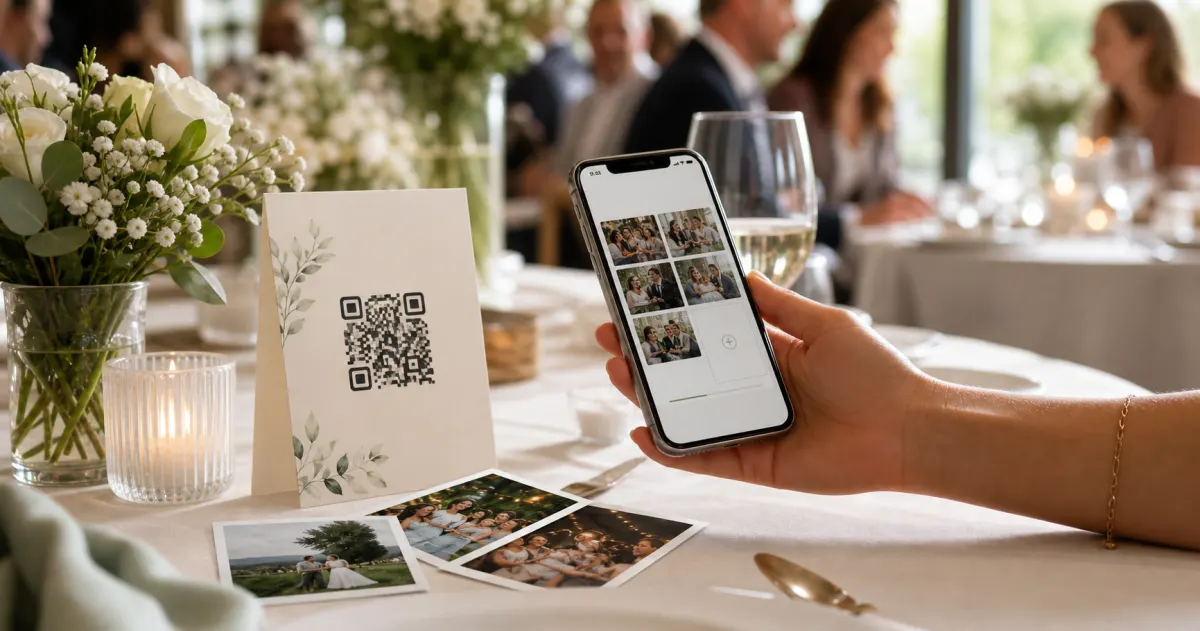 Guide
GuideHow to collect photos from your event guests (the easy way)
A printed QR code on the table collects more photos than any link in a group chat -- here is why, and how to set one up in two minutes.
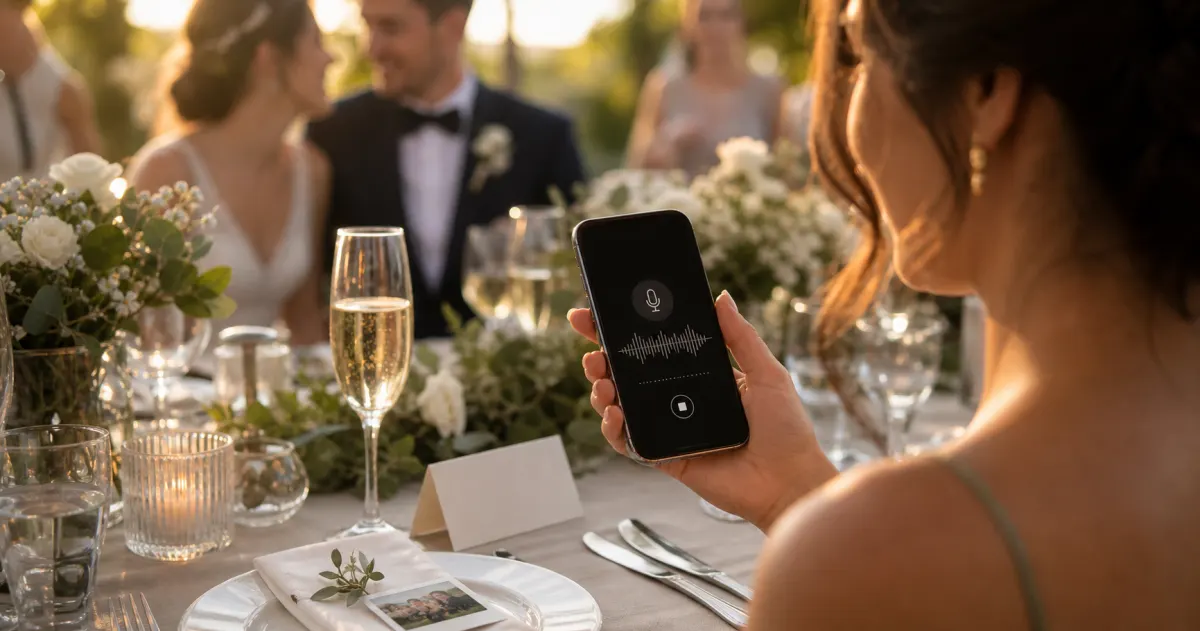 Story
StoryThe most underrated wedding keepsake: guest voice messages
Guest voice messages are the wedding keepsake couples replay most -- real voices, real pauses, the things people said when they actually meant them.
 Guide
GuideCollecting guest photos in the EU without the GDPR headache
Consent, data residency, and erasure -- the three things that make event-media GDPR-compliant, and how to get them right by default.