Event Photo Sharing for Resellers: How to Offer White-Label Albums Under Your Brand


If you run events for other people — as a photographer, a planner, an agency, a venue, or an AV/photo-booth supplier — you've almost certainly watched guest photos scatter across a dozen phones and never make it back to your client. A QR-code photo-sharing album fixes that. The question for a reseller isn't whether to offer one; it's how to offer it under your own brand, so the experience looks like yours, the client relationship stays yours, and the recurring revenue lands with you.
This is a practical guide to doing exactly that: what "white label" actually means in this category (the word is abused), how reseller pricing models work, the GDPR contract you need before you resell, and how to package and place it at a real event. Competitor prices are verified from their own pages as of June 2026 and kept in their native currency.
A note on the keyword. Almost nobody types "event photo sharing reseller white label" into a search box — it's a category description, not a question. We've written this for the people behind that phrase: professionals deciding how to add guest-media collection to what they already sell. If you want the buyer's-checklist version, see our companion piece on what agencies should look for in white-label event photo sharing.
What "white label" really means here (and what it usually means)
"White label" gets stamped on a lot of products that aren't. In this market it's worth being precise, because the depth determines whether the experience actually looks like yours or just mentions you. There are three rough levels:
- Cosmetic branding — you upload a logo and pick an accent colour. The guest page, the album, and any emails may still live on the vendor's domain and carry traces of the vendor's name. In our competitor register, GuestCam lists a custom-logo/white-label option as a quote-only add-on, Kululu offers a "Remove Kululu Branding" toggle, and Fotify, Wedibox, and WedUploader offer logo-and-colour personalisation only. (verified from each provider's pages, 2026-06-08.)
- End-to-end white label — your brand on the whole journey: the guest landing page, the album, the QR code's destination, and the outbound email (and ideally SMS), served from your own custom domain. Guests never see the vendor. This is the level that actually lets you resell as a product.
- Full white label + control plane — everything above, plus a branded SMS sender, single sign-on for your team, an API to wire it into your own systems, and a contract that names you as the controller's processor. This is what an agency running dozens of events a year needs.
Only a handful of tools reach level 2 or 3. Eventiere advertises a full-reseller programme on its Professional/Enterprise tiers (pricing on request), memoryKPR's Business tier offers white-labelled storage (from $250 one-time / $199/mo, as of June 2026), and JoinMyMoment lists a B2B/white-label/reseller/API tier at pricing on request. Guestlense runs a vendor "Pro" subscription ($79–$299/mo, as of June 2026) but its host-facing branding is cosmetic. Most of the rest stop at level 1.
Gathmo is built for levels 2 and 3: a custom domain, branded email, and a branded SMS sender (top tier) mean guests see your brand end to end — the whole point if you're reselling.
How reseller pricing models work
There are two structures in this market. The first is one-time, per-event, resold at a markup: you buy an album per event and bill it inside your package. Simple, no commitment — but you pay full sticker every time, and many one-time consumer tools were never designed to be resold, so margin and branding are both thin. The second is the reseller model proper — a subscription with an event pool: a monthly or annual fee that includes a pool of events at a falling per-event cost, plus the white-label depth that makes resale viable. The more events you run, the cheaper each one gets, and the brand stays yours throughout.
Gathmo's B2B ladder is built on that second model. The three tiers, EUR-canonical (annual = pay 10 months, so 2 months free):
| Tier | Price (mo / yr) | Seats | Events / yr | White-label depth | API / SSO |
|---|---|---|---|---|---|
| Studio | €39 / €390 | 1 | 10 | Logo + accent + branded album; 1 custom domain | — / — |
| Agency ★ | €99 / €990 | 5 | 50 | End-to-end (guest page + album + QR landing + email/SMS), multi-brand, multiple custom domains | API / — |
| Enterprise | from €399 / custom | ∞ | ∞ | Full WL + branded SMS sender, SSO/SAML, SLA | API + SSO/SAML |
The volume logic is the reason to look past the monthly number. On the annual plan, Studio is €390/year for 10 events, and Agency is €990/year for 50 events. Studio is the on-ramp for a solo professional; Agency is where end-to-end white label, API access, and unlimited custom domains switch on. (Gathmo figures: research-foundation/07-gathmo-product-facts.md and the internal B2B tier spec.)
A note on honesty, because it matters when you're putting your name on something: Gathmo does not offer face-recognition photo search or RSVP at launch. Both are on the roadmap, not in the product today. If a client's brief depends on selfie-based photo finding right now, a tool like GuestCam (its MagicFind add-on, $45 one-time, as of June 2026) does that today — we'd rather you knew that than be surprised on event day.
The contract you need before you resell: a DPA
This is the part most "how to resell" guides skip, and it's the part that protects you. The moment you collect guests' photos and voice messages on behalf of a client, two legal roles appear: the controller (usually the event host, who decides why the data is collected) and the processor (who processes on documented instructions). That relationship must be governed by a binding written contract — a Data Processing Agreement (DPA) under GDPR Art. 28(3), which has to set out the subject-matter, duration, nature and purpose of the processing, the types of data and categories of data subjects, and the processor's obligations.
So before you resell, make sure your platform will sign a DPA with you (Gathmo offers one to business customers). Three more obligations to build into how you run events:
- Tell guests at the point of collection. Under GDPR Art. 13(1), when you collect data directly from people you must, at that moment, provide a clear notice: who controls the data, the purpose and legal basis, and their rights. In practice that's a short privacy line on the scan/landing page — easy to do, often forgotten.
- Be able to honour deletion. A guest can ask for their data to be erased (GDPR Art. 17(1), the "right to be forgotten"), and you must act without undue delay and in any event within one month (Art. 12(3), extendable by two further months for complex cases). Your platform needs a real delete, not a hide.
- Set a retention period. GDPR Art. 5(1)(e) (storage limitation) and Art. 5(1)(c) (data minimisation) mean event galleries shouldn't live forever. Gathmo's tiers auto-expire (from 30 days on Free up to 365 days on the top B2C tier), which is the compliant default — a deliberate retention window rather than indefinite storage.
Where the data physically sits is a genuine differentiator you can sell. Most tools in this category are US-hosted (GuestCam, Kululu, Fotify, Wedibox, among others, as of June 2026). Gathmo hosts in the EU (Frankfurt) with processor DPAs in place — which, for EU weddings, kids' parties, and corporate events, removes the international-transfer question your more compliance-conscious clients will eventually ask about.
This section is general information, not legal advice. Confirm your own controller/processor roles and obligations with a qualified adviser for your jurisdiction.
How to package and place it at an event
Two practical pieces turn "we offer photo sharing" into something a client actually experiences as your product.
Package it, don't itemise it. Resellers who win don't sell "a QR album" as a line item; they fold it into the deliverable the client already wants — "your guests' photos, videos, and voice messages, collected and delivered in a branded album." On a subscription model your marginal cost per event is low (under €20 on the Agency annual plan), so it's an easy inclusion that raises the perceived value of the whole package.
Get the QR code right on the day. A branded album is worthless if guests can't scan it. The print specs that matter:
- Size to scanning distance with the 10:1 rule — printed size ≥ maximum scan distance ÷ 10. A table card (~30–50 cm) wants a 3–5 cm code; an entrance A-frame (1–2.5 m) wants 10–25 cm; a stage banner wants 8–12 inches. Never go below 2 × 2 cm.
- Keep the quiet zone — a blank margin of at least 4 modules on all four sides (ISO/IEC 18004), so the scanner can lock on.
- Overlaying your logo? Use error-correction Level H (~30%) so the code still resolves; plain codes default to Level M (~15%).
- Dark on light, and dynamic. Dark foreground on a light background (avoid inverted light-on-dark), and a dynamic code so you can repoint the destination after printing.
- Test-print and scan it at real size, on the real material, under real lighting — a code that scans on a monitor can fail on glossy stock.
You're not fighting an adoption problem here: QR scanning is mainstream. Roughly 68% of US consumers used a QR code in the past year, 86.66% of UK/EU smartphone users have scanned at least one, and smartphone penetration in Germany sits near 97%. The phone in your guest's pocket is already a scanner — your job is just to make the code easy to find and easy to read.
Register for a Gathmo reseller account
Contact Gathmo to discuss reseller pricing and terms. The reseller programme is designed for event agencies, wedding planners, and venue managers who want to offer branded photo albums without building their own platform.
Create events under client branding
From your reseller dashboard, create each event with the client's logo and colour scheme. The guest-facing upload page shows the client's branding. Download the branded QR code for print production before each event.
Set the appropriate tier per event
Choose the tier based on guest count and session length: Essential (19 EUR, 183-day album) for small events; Celebrate (39 EUR, live wall, 1-year album) for events requiring a live display; Grand (79 EUR, live stream and transcripts) for flagship events.
Deliver the archive to the client after the event
Download the ZIP archive from the dashboard and deliver it to the client within 48 hours alongside an upload count and participation summary. Position this delivery as the standard post-event handoff -- no different from delivering AV footage.
Frequently asked
Yes — but only with a tool that does true white label: your brand on the guest page, the album, the QR destination, and the emails, served from your own custom domain. Cosmetic "logo upload" toggles don't get you there. Gathmo's Agency and Enterprise tiers are built for end-to-end white label.
"White label" is about appearance — whose brand the guest sees. "Reseller" is about the commercial model — you pay a subscription (with an event pool) and sell the result to your own clients. You generally want both: white-label depth so it looks like yours, and a subscription so the per-event cost falls as you scale.
With Gathmo, no — guests scan a QR code or open a short link and upload from any phone's browser, with no app and no signup. It's worth confirming for any tool you resell, because no-friction access is the biggest driver of participation.
It can be, with the right contract and notices: a DPA (Art. 28(3)) with your platform, a privacy notice to guests at collection (Art. 13), a working deletion process (Art. 17), and a defined retention period (Art. 5). EU-hosted data simplifies the transfer question. (General information, not legal advice.)
As a professional photographer delivering images to a client, you are typically a data controller for the photos you capture and process. When you hand images to a client who then manages them — uploading to a shared album, distributing to guests — the client becomes a controller for their use. To cover both parties: include a data-processing clause in your client contract specifying what data you collect, how long you retain your own copies, and that the client takes responsibility for their distribution. This does not need to be complex — two to three sentences in the standard client agreement is usually enough for private events.
Yes, provided you select the platform carefully and document the arrangement. The key step is a DPA with the platform: as the data controller (or joint controller with your client), you need a signed DPA from the platform under Art. 28. Second, choose EU-hosted storage if your clients are EU companies or their guests are EU residents — this avoids the third-country transfer question. Third, communicate the retention window to the client so they download their copies before the album closes. Gathmo provides DPAs and stores data in the EU, which satisfies these requirements for most EU agency-to-client workflows.
Yes. Gathmo's B2B tier includes white-label features: agencies can present the photo gallery and QR album under their own branding — logo, colour scheme, custom domain — without Gathmo branding visible to the end client. The agency pays the wholesale B2B rate and bills the client at their own price. This works for event agencies, wedding planners, conference organisers, and corporate communications teams who want a branded photo experience without building or licensing their own platform. The B2B tier includes DPA support for agency-to-client data processing chains. Per-event pricing means no annual minimum commitment.
 Guide
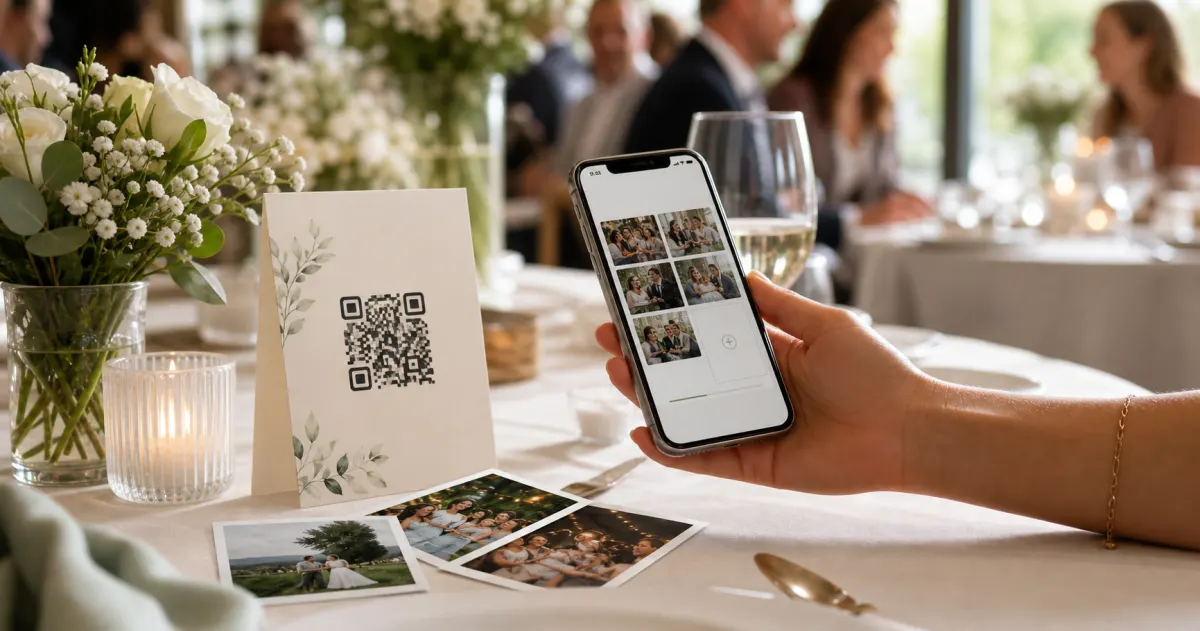
GuideHow to collect photos from your event guests (the easy way)
A printed QR code on the table collects more photos than any link in a group chat -- here is why, and how to set one up in two minutes.
 Guide
GuideCollecting guest photos in the EU without the GDPR headache
Consent, data residency, and erasure -- the three things that make event-media GDPR-compliant, and how to get them right by default.
 Story
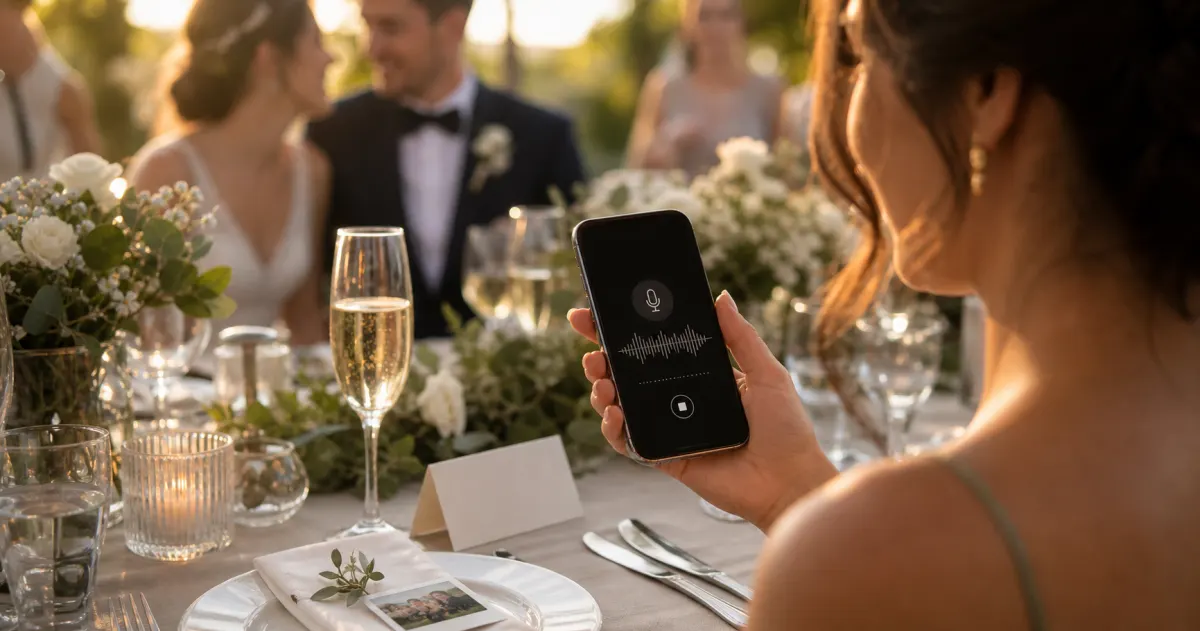
StoryThe most underrated wedding keepsake: guest voice messages
Guest voice messages are the wedding keepsake couples replay most -- real voices, real pauses, the things people said when they actually meant them.